

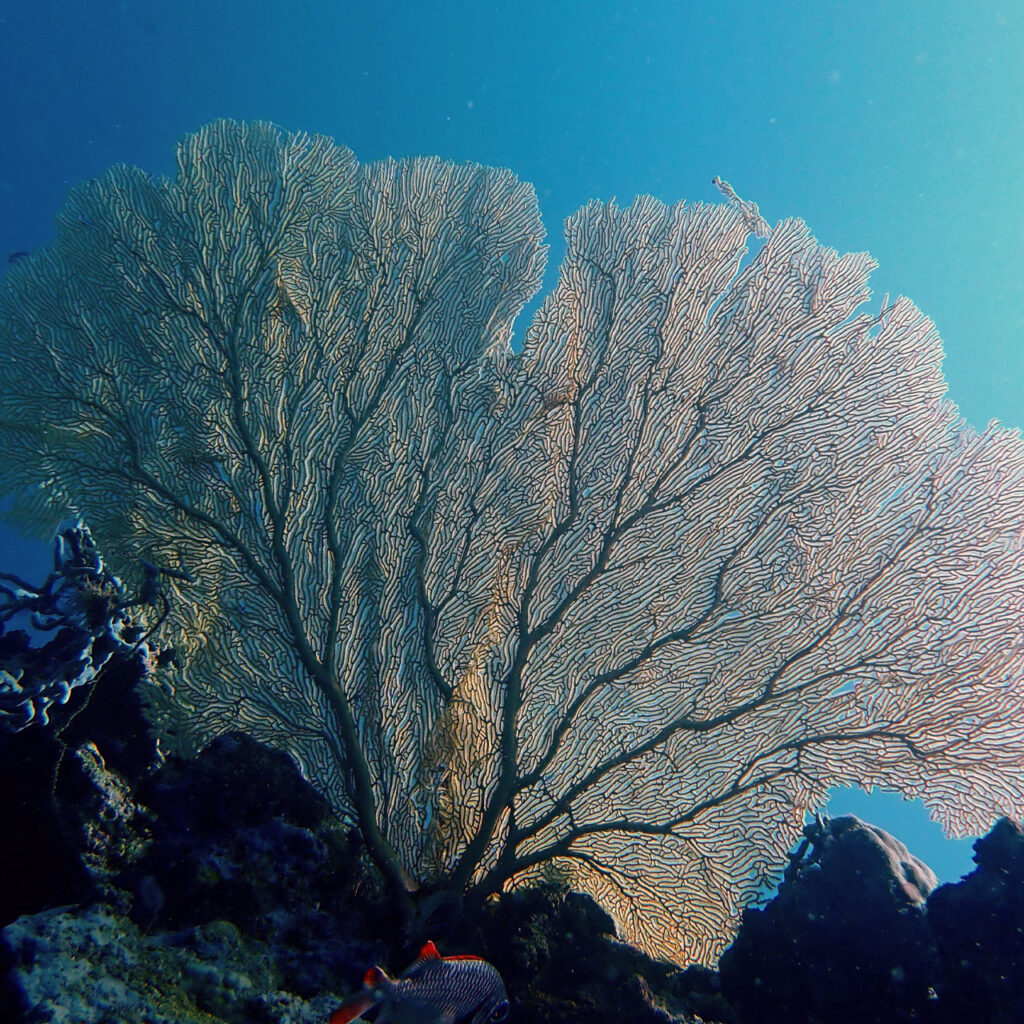
The Ocean’s Underwater Lacework (Graceful, Flexible, and Always in Style)
If coral reefs had couture, Sea Fans would own the runway. These delicate, branching beauties sway like living lace curtains in the current, turning ordinary reef walls into underwater ballrooms. They’re not just decoration—they’re soft corals with a serious ecological role and a flair for drama.
What Exactly Is a Sea Fan?
Sea Fans belong to the Gorgonian family (Order: Alcyonacea), a group of soft corals that trade rigid skeletons for flexibility. Instead of building massive limestone fortresses like hard corals, Sea Fans weave branching networks supported by a protein called gorgonin. This gives them their signature fan-like shape, perfect for catching plankton drifting by.
ID cues:
- Shape: Flat, fan-like structure with intricate branching.
- Texture: Flexible, leathery feel (don’t touch, though!).
- Color: Purples, yellows, reds, and sometimes a mix—like nature’s tie-dye.
- Polyps: Tiny flower-like polyps cover the branches, each a miniature feeding machine.
Lifestyle & Feeding Habits
Sea Fans are filter feeders, relying on currents to deliver plankton and organic particles to their polyps. They don’t chase food—they let the ocean do the work. This is why you’ll find them oriented perpendicular to prevailing currents, maximizing their plankton-catching surface area.
Fun fact: Sea Fans are nocturnal feeders at heart, extending polyps more actively at night when plankton density spikes.
Behavior & Ecological Role
- Habitat architects: Sea Fans create microhabitats for small crustaceans, juvenile fishes, and even cryptic species like blennies and gobies.
- Current indicators: Their orientation tells divers which way the water is flowing—handy for planning your drift.
- Symbiotic relationships: Some host zooxanthellae (photosynthetic algae), though they rely heavily on plankton for nutrition.
Distribution in South Florida
Sea Fans are common on South Florida reefs, especially:
- Florida Keys: From Key Largo to Key West, they dominate shallow reef crests and spur-and-groove formations.
- Broward & Palm Beach: Found on natural reefs and artificial structures where currents are strong.
- Depth range: Typically 10–60 ft, thriving in areas with steady flow and good light.
Look for them:
- On outer reef edges where currents sweep plankton.
- Near patch reefs and channel mouths where water movement is reliable.
Cozumel Cameo
Cozumel’s reefs are practically Sea Fan heaven. Dive sites like:
- Palancar Gardens and Santa Rosa Wall: Fans drape the reef like royal tapestries.
- Colombia Shallows: Vibrant purple and yellow fans sway in gentle surge.
- Tormentos Reef: Dense clusters create a surreal underwater forest.
Photography tip: Position yourself down-current and shoot upward for dramatic silhouettes against the blue. Avoid touching or fin kicks—these delicate structures break easily.
If you haven’t gotten your deposit in for Cozumel, the deadline is right around the corner.
Threats & Conservation
Sea Fans face challenges from:
- Storm damage and surge.
- Diseases like aspergillosis, a fungal infection linked to environmental stress.
- Pollution and sedimentation, which clog polyps and reduce feeding efficiency.
What divers can do:
- Perfect buoyancy—don’t crash into fans.
- Avoid stirring sediment.
- Support reef protection initiatives that maintain water quality.
Quick Facts (Pin These to Your Slate)
- Type: Soft coral (Order: Alcyonacea)
- Structure: Flexible, fan-shaped branches
- Color palette: Purple, yellow, red
- Diet: Plankton via filter feeding
- Habitat: Reef slopes, walls, and current-swept zones
- Depth: 10–60 ft (sometimes deeper)
- Role: Habitat provider, current indicator, reef beautifier
“Where to Spot Them” (South Florida & Cozumel)
- South Florida:
- Florida Keys reefs (Molasses, French Reef, Conch Reef)
- Broward/Palm Beach ledges and wrecks with good current
- Cozumel:
- Palancar Gardens, Santa Rosa Wall, Colombia Shallows, Tormentos Reef
Photography Tips
- Use natural light for shallow fans; strobes for deeper shots.
- Frame against blue water for contrast.
- Avoid touching—fans are fragile and slow to recover from damage.
Final Thoughts
Sea Fans are the reef’s poetic flourish—graceful, essential, and endlessly photogenic. Whether you’re drifting along South Florida’s reefs or gliding past Cozumel’s walls, these soft corals remind us that beauty and function can coexist. They’re not just scenery—they’re living, breathing parts of the ocean’s grand design. Treat them gently, admire them deeply, and let their quiet elegance inspire your next dive.
Content created by Gen AI but edited by scuba divers for scuba divers. Image courtesy of Frédéric Ducarme, CC BY-SA 4.0, via Wikimedia Commons
