

Cozumel’s Grumpy, Glorious Secret (Who Also Visits South Florida)
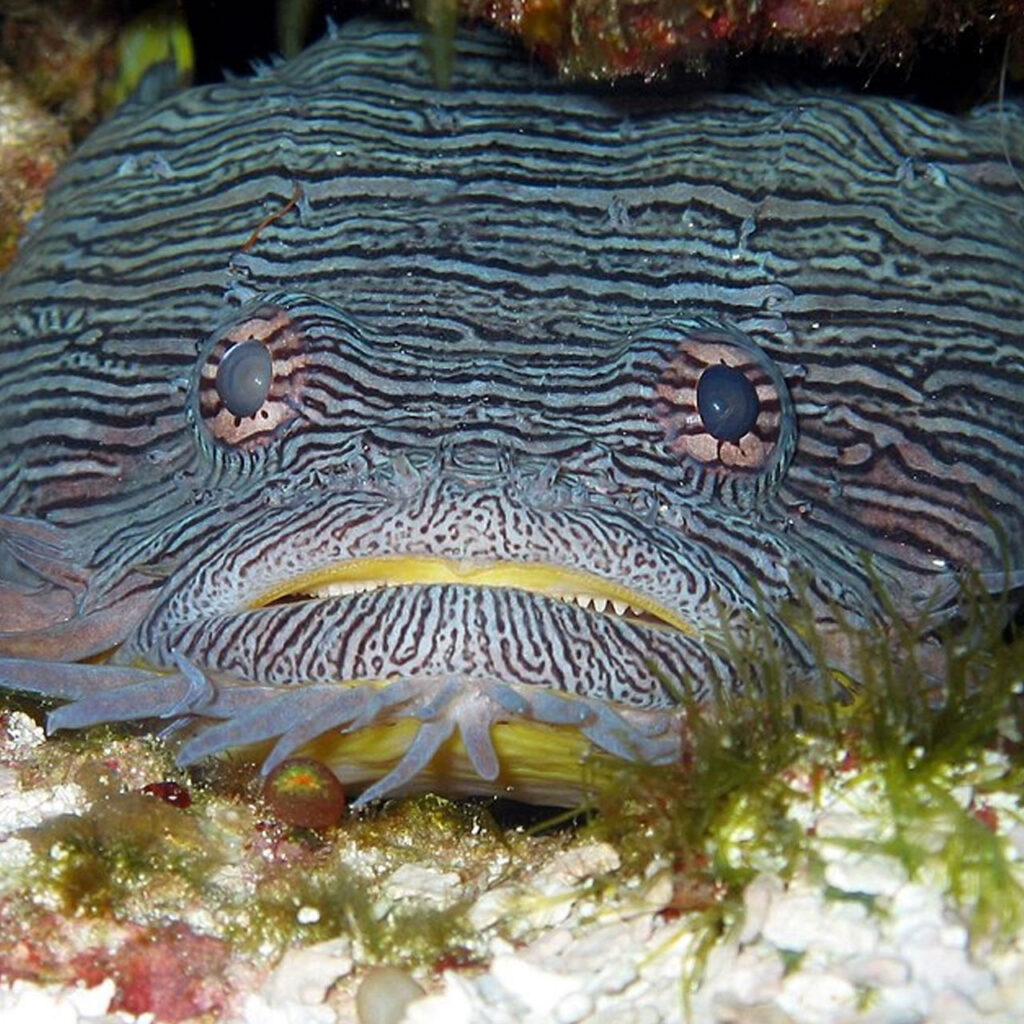
Meet the curmudgeon of the coral reef: a fish with a face only a scuba diver could love. The Splendid Toadfish (Sanopus splendidus) looks like someone crossbred a catfish with a stripy rug and gave it neon highlights. It’s all part of the charm. Around Cozumel it’s practically a diving rite of passage to spot one peeking out from an undercut, whiskers quivering and attitude fully loaded.
What Is a Splendid Toadfish, Really?
Despite the name, it’s not a true toad, nor does it hop (unless we count the bouncy way it shifts around its burrow). It’s a toadfish, a bottom-dwelling ambush predator with chin barbels (glorious whiskers) and a low-slung body. The Cozumel population is special: the Cozumel Splendid Toadfish is a celebrated local icon with blue-and-yellow striping and gorgeous filamentous fins. Think “grouchy carnival.”
ID Tips (So You Don’t Confuse It with Random Reef Riff-Raff)
- Face: Flat and broad, with a “Why are you in my living room?” look.
- Color: Blue or violet tones with bright yellow lines, especially on fins and the face; variable striping along the body.
- Whiskers: Prominent barbels under the chin.
- Fins: Often splayed elegantly around a burrow entrance like a frilly doormat.
- Behavior: Shy. Typically stays half-hidden, showing just enough to photobomb your dive log.
Habitat & Lifestyle
Splendid Toadfish are burrow architects. They dig under coral heads, ledges, and rubble fields, creating snug dens with one (or sometimes two) entrances. They sit there, patient and powerful, waiting for snacks to wander by. Nocturnal ambitions kick in around dusk: that’s the toadfish’s version of “DoorDash.”
Diet (A.K.A. Reef Room Service)
These guys are ambush feeders. They’ll inhale:
- Small fishes that get just a bit too curious
- Crustaceans (shrimp and small crabs are favorites)
- Worms and other invertebrate tidbits
They’re not speedsters. Their hunting relies on stillness, camouflage, and a spectacular “gotcha” gulp.
Predators & Defense
Bigger reef predators—groupers, snappers, and morays—may take a chance if the toadfish ventures out too far. The Splendid Toadfish’s best defense is real estate: burrows with good sightlines, easy retreat paths, and just enough cover to keep paparazzi at bay.
Distribution in South Florida
While Cozumel is the poster child for the Splendid Toadfish (more on that in a moment), toadfish in general are found across the tropical western Atlantic and Caribbean, and divers in South Florida occasionally encounter toadfish species (including splendid-looking individuals) around coral and rubble habitats from the Keys up through the southeast Florida reef tract.
Look for them:
- Under ledges and patch reefs in Biscayne and the Upper Keys
- In rubble zones and spur-and-groove formations off Key Largo and Islamorada
- Rare but possible sightings around Fort Lauderdale artificial reefs, if conditions and substrate suit burrow-building
They’re never “schooling fish” you’ll see cruising midwater—they’re homebodies. If you want to find one in South Florida, slow down, scan patiently, and watch for the whiskers and striped face in dim recesses.
Pro tip: Take your time. Hover steady. When you spot a likely burrow entrance, step back (figuratively), avoid blasting the entrance with light, and let your eyes adjust. The Splendid Toadfish might edge forward for a peek if it doesn’t feel threatened.
Cozumel Cameo
Cozumel’s reefs are famously toadfish-friendly, and many local dive sites have “resident” individuals:
- Paradise Reef and Chankanaab: Great for first-time sightings on shallower dives.
- Santa Rosa and Palancar: Look beneath ledges, particularly in sand channels between reef spurs.
- Tormentos: Known for lively currents and sneaky den entrances.
Cozumel Splendid Toadfish often pose for photos from their burrows—half out, half in, fins framing the doorway like a velvet curtain. If you keep your breathing calm and your fins off the bottom, you’ll get the classic portrait: head-on, whiskers glowing, striping vivid.
Etiquette: No poking, no feeding, and definitely no excavations. Burrows are essential refuges—disturbing them can harm the fish and destabilize the microhabitat.
If you’re not signed up for the 2026 Out Scuba Cozumel trip, make sure you don’t miss out on these bucket list fish.
Behavior That Makes Them… Well… Splendid
- Acoustic stars: Toadfish are known for vocalizations, especially during courtship—low, resonant “boat horn” vibes. You may not hear Cozumel’s residents over your bubbles, but it’s part of their secret nightlife.
- Burrow shenanigans: They’ll tidy, expand, and redecorate (with rubble) like tiny underwater interior designers.
- Macro-photography gold: The contrast of blue, yellow, and fine striping makes them irresistible subjects. Photographers: aim for diffused lighting to preserve colors and avoid startling the fish.
Conservation & What Divers Can Do
While the Splendid Toadfish isn’t typically the headline species for conservation campaigns, healthy reefs are non-negotiable for their survival. Good practices:
- Perfect buoyancy: Avoid fin kicks into sand and rubble that can collapse burrows.
- No touch, no tease: Resist the urge to coax them out.
- Respect protected areas: Cozumel marine park rules (and South Florida area regulations) help keep habitats intact.
Quick Facts (Pin These to Your Slate)
- Family: Batrachoididae (toadfishes)
- Signature look: Blue/violet tones, yellow striping, chin barbels
- Lifestyle: Burrow-dwelling ambush predator
- Best times to spot: Daytime (peeking), dusk/night (more activity)
- Where to look: Under ledges and coral heads, rubble edges, sand channels
- Photographer tip: Move slow, light soft, and watch those whiskers
Where to Spot Them (South Florida & Cozumel)
- South Florida: Key Largo patch reefs; ledgy spots in the Upper Keys; occasional sightings on Broward/Palm Beach artificial reef structures with suitable rubble pockets.
- Cozumel: Paradise Reef, Chankanaab, Tormentos, Santa Rosa, Palancar—essentially any reef with undercuts and steady current.
Content created by Gen AI but edited by scuba divers for scuba divers. Image courtesy of Randall McNeely
