

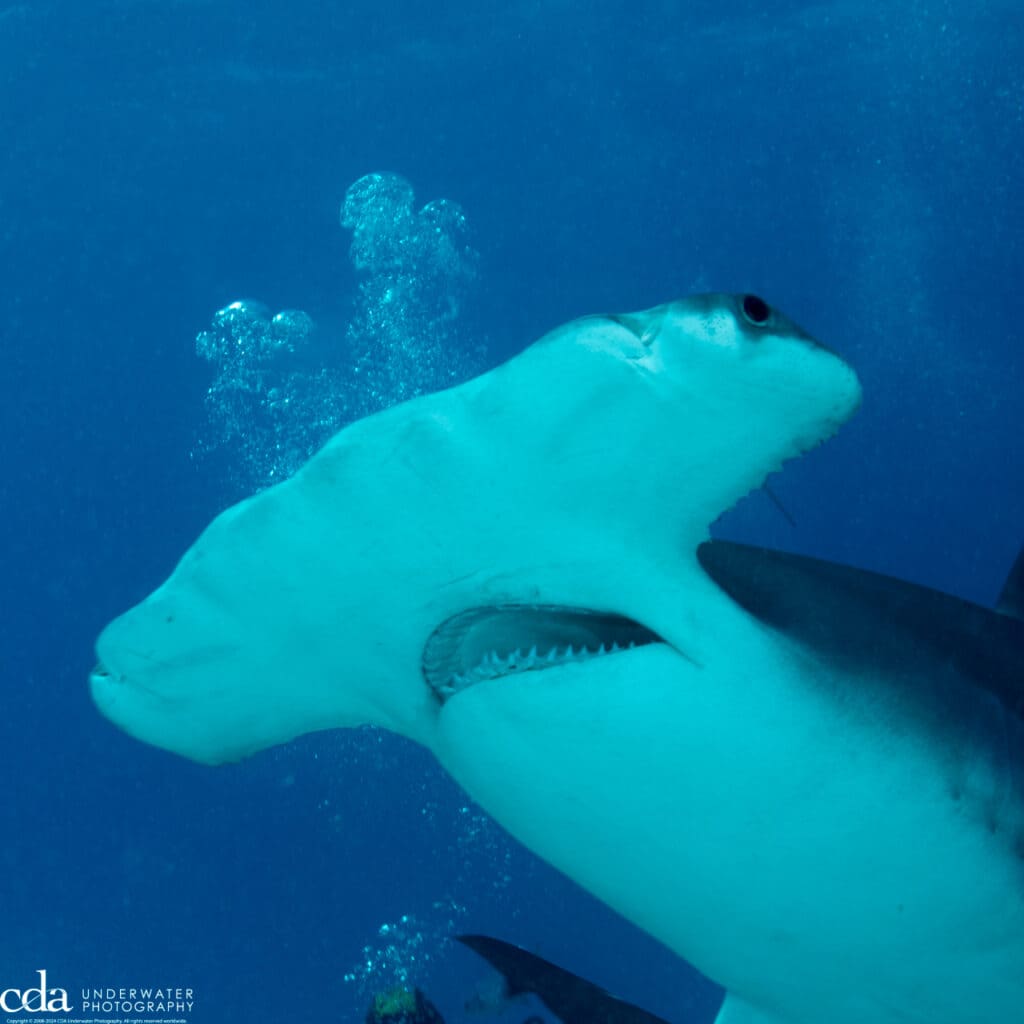
The Great Hammerhead (Sphyrna mokarran) is one of the most recognizable sharks in the ocean. With its wide, flattened head and powerful body, it looks like something out of a prehistoric dream—and it’s just as formidable. This species is the largest of the hammerhead family and commands attention wherever it’s seen, whether cruising along a reef or gliding through open water.
Its unique appearance isn’t just for show. The Great Hammerhead is a highly evolved predator, equipped with specialized tools and behaviors that make it one of the ocean’s most efficient hunters. In South Florida, it’s a seasonal visitor and a thrilling sight for divers lucky enough to encounter one.
Fun Fact First
That hammer-shaped head—called a cephalofoil—is more than just a visual trademark. It’s packed with sensory organs, including ampullae of Lorenzini, which detect the electric fields produced by prey. This allows the Great Hammerhead to locate stingrays and other hidden animals buried beneath the sand.
The head also serves a mechanical purpose. Its broad shape improves maneuverability, giving the shark a tighter turning radius than most other species. This is especially useful when hunting agile prey or navigating complex reef structures. The cephalofoil also enhances binocular vision, allowing the shark to better judge distances and track moving targets.
Where to Find Them
Great Hammerheads roam offshore reefs, drop-offs, and open water throughout South Florida. They’re most commonly seen in the Florida Keys, as well as deeper waters off Miami, Fort Lauderdale, and Palm Beach. These sharks prefer warm, tropical waters and are often found near coral reefs, seagrass beds, and sandy flats where prey is abundant.
They’re migratory, following seasonal patterns based on water temperature, prey availability, and breeding cycles. In South Florida, sightings tend to peak during the winter months, when cooler waters bring stingrays and other prey species closer to shore. Some hammerheads also pass through during spring and fall migrations, making them a year-round possibility for lucky divers.
While they’re not commonly seen on shallow recreational dives, advanced divers and snorkelers may spot them on deeper reef walls or during drift dives in open water. Shark diving tours in the Bahamas and Jupiter, Florida, sometimes encounter Great Hammerheads as part of their pelagic shark experiences.
Habits and Behavior
Great Hammerheads are solitary hunters, often cruising the reef with slow, deliberate movements. Unlike some shark species that hunt in groups or display social behavior, hammerheads tend to keep to themselves. Their hunting style is methodical—they glide just above the seafloor, scanning for prey with their electroreceptors.
One of their favorite meals is the stingray. Hammerheads are known to use their wide heads to pin stingrays to the bottom, immobilizing them before delivering a fatal bite. This technique is both brutal and effective, showcasing the shark’s strength and precision.
Despite their size and fearsome reputation, Great Hammerheads are generally shy around humans. They rarely show aggression unless provoked, and most encounters with divers are brief and peaceful. Their cautious nature makes them difficult to study in the wild, but it also contributes to their mystique.
They’re also known to exhibit vertical swimming behavior, sometimes rising toward the surface in a spiraling motion. This may be related to feeding, navigation, or thermoregulation. Observing this behavior is rare but awe-inspiring.
What They Eat (and Who Eats Them)
Great Hammerheads are apex predators, meaning they sit at the top of the food chain. Their diet includes stingrays, squid, octopus, crustaceans, and smaller fish. Their electroreceptors allow them to detect prey even when it’s buried under sand, giving them a distinct advantage in shallow reef environments.
They’re opportunistic feeders and may also scavenge when the opportunity arises. Juvenile hammerheads, however, are more vulnerable and may fall prey to larger sharks, including tiger sharks and bull sharks. As they grow, their size and strength make them less susceptible to predation.
Unfortunately, the greatest threat to Great Hammerheads is humans. They are heavily targeted in commercial fishing, especially for their fins, which are highly valued in the international shark fin trade. This has led to significant population declines in recent decades.
They’re also caught as bycatch in longline and gillnet fisheries, and their slow reproductive rate makes recovery difficult. Females give birth to live young—usually between 20 and 40 pups—but only every two years, making population growth slow and fragile.
Why They’re Interesting
The Great Hammerhead’s unique head shape, hunting strategy, and sensory adaptations make it one of the most studied shark species in the world. Marine biologists are fascinated by its cephalofoil, which offers insights into evolution, biomechanics, and predator-prey dynamics.
Its role as an apex predator also makes it a keystone species—one that helps regulate the health of reef ecosystems. By controlling populations of stingrays and other prey, hammerheads contribute to the balance of marine food webs.
They’re also a conservation priority. Due to overfishing, habitat loss, and slow reproduction, Great Hammerheads are listed as Critically Endangered by the IUCN. Conservation efforts include fishing regulations, protected areas, and public awareness campaigns aimed at reducing demand for shark fins and promoting sustainable tourism.
In South Florida, organizations like Shark Allies, Bimini Shark Lab, and Florida Fish and Wildlife Conservation Commission (FWC) are working to protect hammerheads and other vulnerable shark species. Divers and snorkelers can support these efforts by choosing eco-friendly dive operators, avoiding products made from sharks, and sharing their experiences to raise awareness.
Final Thoughts
The Great Hammerhead is more than just an iconic predator—it’s a symbol of the ocean’s complexity and beauty. Its distinctive shape, powerful presence, and fascinating behavior make it a favorite among divers, scientists, and conservationists alike.
In South Florida, encountering a Great Hammerhead is a rare and unforgettable experience. Whether you see one gliding over a reef wall or hear stories from fellow divers, it’s a reminder of the wild, untamed world that exists just beneath the surface.
As we learn more about these incredible animals, it becomes clear that protecting them is not just about saving a species—it’s about preserving the balance of our oceans and the wonder they inspire.
Content created by Gen AI but edited by scuba divers for scuba divers. Image courtesy of Christopher Duncan, copyright 2025 CDA Underwater Photography, all rights reserved worldwide.