

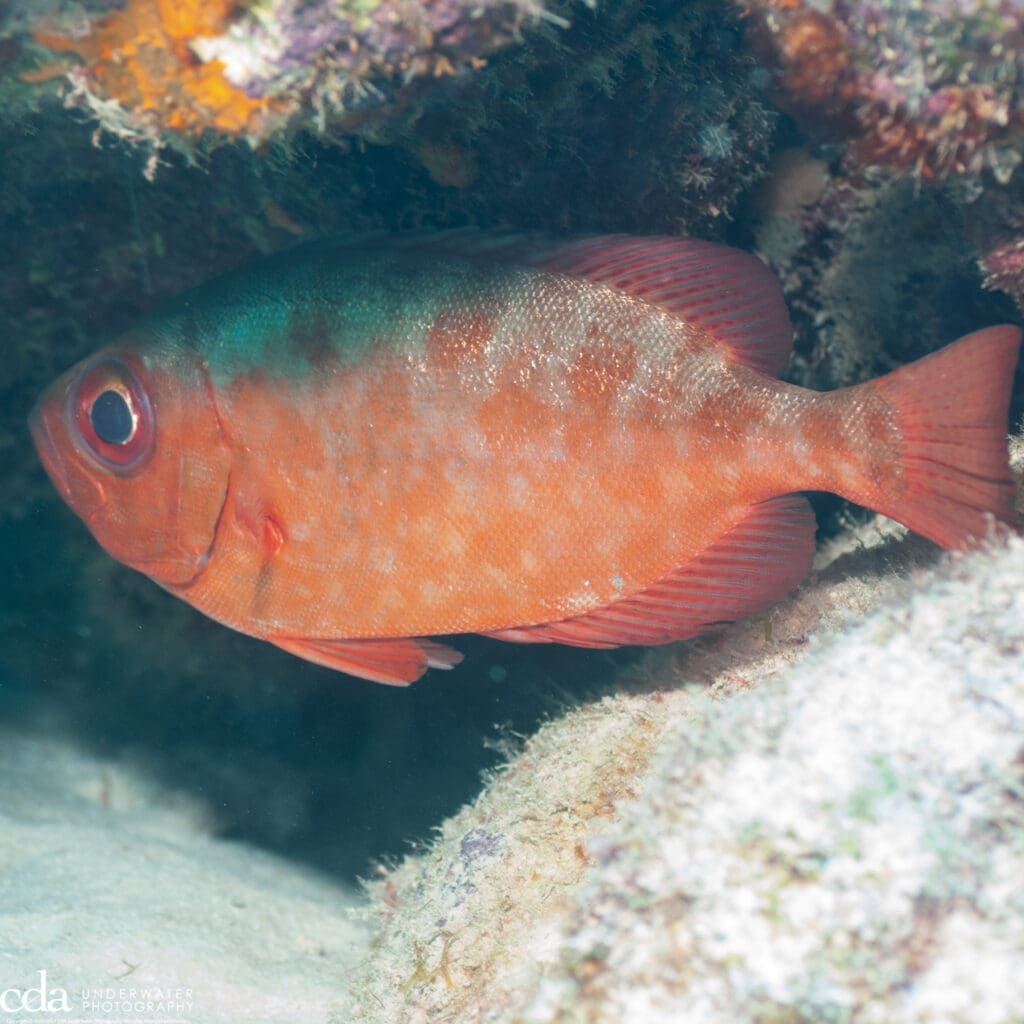
The Bigeye (Priacanthus arenatus) is a nocturnal fish with—you guessed it—huge eyes. These crimson-red hunters are built for low-light conditions and spend their days hiding in caves, only emerging when the sun goes down. If you see one during a day dive, count yourself lucky. We can only assume that the bright light of day must hurt their sensitive eyes.
Fun Fact First:
Bigeyes have exceptional night vision, thanks to their oversized eyes and specialized retinas. They’re like the night-vision goggles of the reef, able to spot prey in near-total darkness. Bigeyes and soldierfish are related—they both belong to the same family, Holocentridae, which includes a variety of nocturnal reef fish known for their bright red coloration and large eyes. However, they fall into different subfamilies within that group, and there are some notable differences between them.
Bigeyes, which are part of the Holocentrinae subfamily, are known for their exceptionally large eyes. These eyes are an adaptation to their nocturnal lifestyle, helping them see in low-light conditions as they forage at night. Bigeyes tend to have a more elongated and laterally compressed body shape, and their coloration is often reddish or silvery. They’re typically solitary or found in small groups, hiding in reef crevices during the day and emerging at night to feed.
Soldierfish, on the other hand, belong to the Myripristinae subfamily. While they also have large eyes suited for nighttime activity, their eyes are generally smaller than those of bigeyes. Soldierfish have a more robust and deeper-bodied appearance, and they’re often seen in larger schools. Their coloration is usually bright red or orange, and they tend to be slightly more social than bigeyes, sometimes forming aggregations in reef overhangs or caves.
Both types of fish are common in South Florida reefs and are frequently spotted during night dives. Their shared traits—like nocturnal behavior and vivid coloration—can make them seem very similar at first glance, but their body shape, eye size, and social habits help divers and marine enthusiasts tell them apart.
Where to Find Them
You’ll find Bigeyes in deep reef zones, caves, and wrecks throughout South Florida. They prefer shadowy environments and are often seen hovering near ledges or tucked into crevices.
They’re most active at night, making them a favorite among night divers.
Habits and Behavior
Bigeyes are solitary and shy. During the day, they hide in dark spaces, often in groups for safety. At night, they emerge to hunt, using stealth and speed to catch prey.
They’re also known for their startle response—flash a light on one, and it might dart away in a blur.
What They Eat (and Who Eats Them)
Bigeyes feed on small fish, crustaceans, and plankton, using their keen vision to hunt in low light. Predators include larger nocturnal hunters like moray eels and sharks.
Why They’re Interesting
Their adaptations for night hunting make them a fascinating study in sensory biology. They’re also a good indicator of reef health, as they prefer clean, undisturbed habitats.
The color red actually plays a fascinating role in the underwater world—especially for nocturnal hunters like the bigeye. While it might seem counterintuitive at first, red coloration can be a strategic advantage for these fish.
In shallow water, red is a vivid and noticeable color. But as you go deeper—especially beyond 10 to 15 feet—red wavelengths are absorbed quickly, making red objects appear dark or even black. This means that a fish with red coloration becomes nearlyinvisible in deeper or dimly litenvironments, like the crevices and caves where bigeyes often hunt at night.
For the bigeye, this camouflage helps in two key ways:
- Stealth: Their red bodies blend into the shadows, allowing them to sneak up on prey without being easily seen.
- Protection: It also helps them avoid detection by predators while they’re out foraging.
So while their large eyes help them see in low light, their red coloration helps them stay hidden—making them efficient and elusive nocturnal hunters.
Content created by Gen AI but edited by scuba divers for scuba divers. Image courtesy of Christopher Duncan, copyright 2025 CDA Underwater Photography, all rights reserved worldwide.