

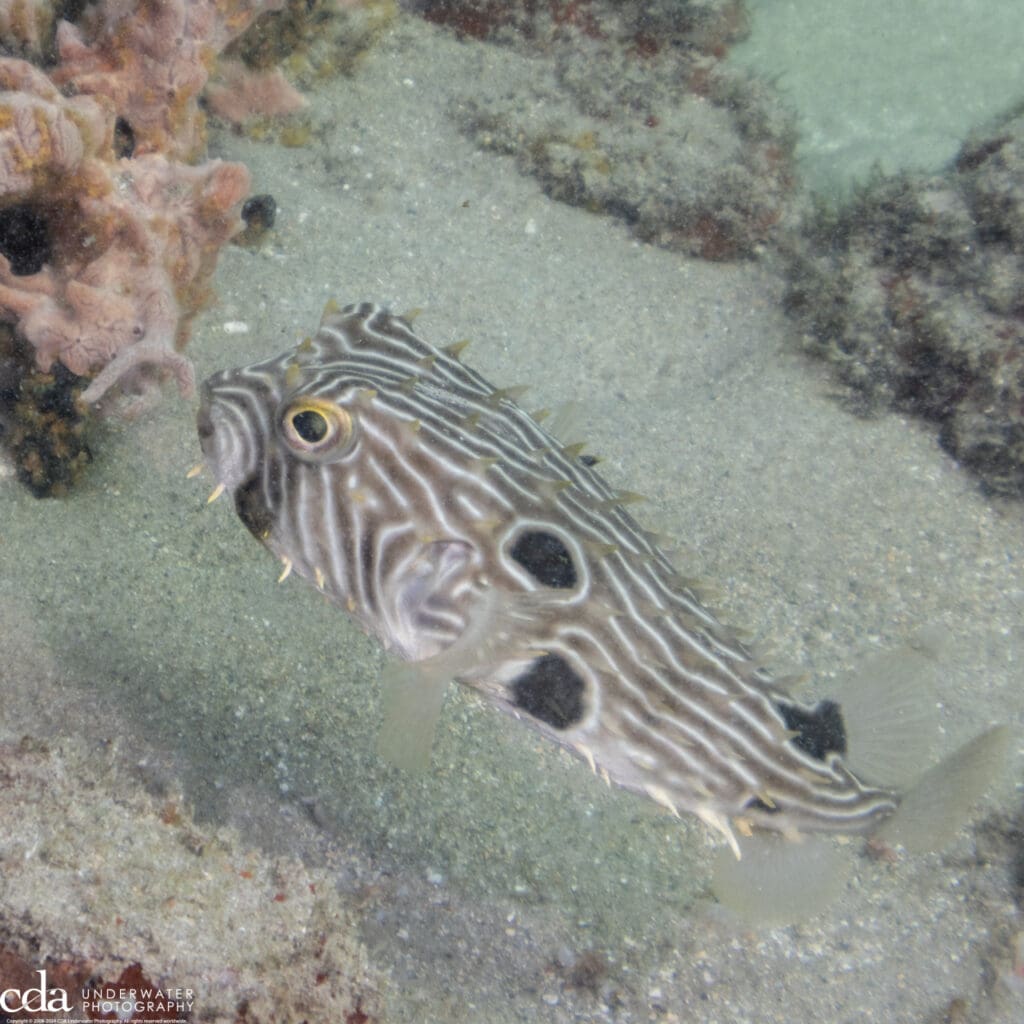
Alright, let’s dive in to another #fff—pun absolutely intended—because the striped burrfish (Chilomycterus schoepfi) is one of those quirky little ocean characters that deserves way more love than it gets. If you’ve ever been scuba diving in South Florida and spotted what looked like a spiky, wide-eyed balloon with fins, chances are you’ve met one of these guys. They’re like the ocean’s mix of a hedgehog, a beach ball, and a grumpy old man… in the best possible way.
Where You’ll Find Them in South Florida
South Florida is basically prime real estate for the striped burrfish. They’re common from the northern Gulf of Mexico all the way down to Brazil, but our warm, shallow coastal waters are like their favorite vacation home. If you’re in the Fort Lauderdale, Miami, or Palm Beach area, you’re in their backyard.
They especially love seagrass beds, coastal lagoons, and shallow reefs—the kind of places where there’s plenty of cover and a buffet of crunchy snacks. You might also spot them hanging around Blue Heron Bridge in Riviera Beach, which is famous for its macro life and calm conditions. In winter, they sometimes venture onto reefs, but most of the time they’re cruising the grass beds like they own the place.
Scuba Diver’s Guide to Spotting One
If you’re a diver looking to meet a burrfish, here’s the trick: slow down. These aren’t speed demons—they’re more like the Sunday drivers of the reef. Look for them hovering just above the sand or weaving through turtle grass. They’re not shy, but they’re also not going to swim right up to you unless they’re feeling particularly curious.
Best bets for sightings in South Florida:
- Blue Heron Bridge – Shallow, protected, and full of life.
- Inner reef systems off Fort Lauderdale and Pompano Beach – Especially in the 15–40 ft range.
- Seagrass beds near inlets – They love the mix of shelter and food.
Pro tip: Approach slowly and from the side. If they feel threatened, they’ll puff up into a spiky ball, which is adorable to us but stressful for them. NEVER try to make a burrfish “balloon” up.
What’s on the Menu?
Striped burrfish are basically the nutcrackers of the sea. Their beak-like teeth are fused into a tough “V” shape, perfect for crunching through hard shells. Their diet includes:
- Oysters
- Barnacles
- Mussels
- Small crabs
- Hermit crabs (shell and all!)
- Snails
- The occasional small fish or sea urchin
They’re nocturnal hunters, so most of the serious snacking happens at night. During the day, you might catch them nibbling here and there, but after dark, they’re out on the prowl.
Their Role in the Ecosystem
Here’s where it gets cool: by feeding on hard-shelled invertebrates, burrfish help keep populations of barnacles, mussels, and other reef encrusters in check. This prevents these critters from overgrowing and smothering corals or seagrass. In other words, they’re like the reef’s maintenance crew—quietly doing important work while looking fabulous.
They’re also part of the food web, though not many predators are willing to take them on. Between their always-erect spines and their ability to puff up to nearly twice their size, they’re a tough meal to swallow. Some larger predators might try, but most think twice.
Family Ties: Burrfish, Pufferfish, and Porcupinefish
The striped burrfish belongs to the family Diodontidae, which makes them a type of porcupinefish. They’re close cousins to the more famous pufferfish (family Tetraodontidae), and both families are part of the order Tetraodontiformes—a group that also includes boxfish and triggerfish.
Here’s the family drama:
- Pufferfish can move their spines (if they have them) and often have smoother skin.
- Porcupinefish (like the burrfish) have spines that are always erect—no folding them down.
- Burrfish are basically the “short-spined” branch of the porcupinefish family tree.
They all share the same inflation trick: gulping water (or air, if they’re out of the water) into a special stomach pouch to balloon up when threatened. It’s not just for show—it makes them harder to bite and swallow.
Distinguishing Marks
If you’re trying to ID a striped burrfish, here’s your checklist:
- Body color: Yellow-green to brownish on top, pale yellow or white underneath.
- Stripes: Wavy, dark brown to black stripes running diagonally down the body.
- Spots: Large dark blotches—one just below the dorsal fin and another behind the pectoral fin.
- Eyes: Big, golden-yellow eyes with iridescent blue-green flecks.
- Spines: Short, thick, and always sticking out.
- Size: Usually 4–8 inches, maxing out around 10 inches.
They also have a kind of “boxy” body shape, which, combined with their slow swimming style, makes them look like they’re just drifting through life without a care.
Personality and Behavior
I know it’s weird to talk about a fish’s “personality,” but burrfish really do have a certain vibe. They’re curious but cautious, often watching divers with those big eyes before deciding whether to stick around. They’re solitary by nature, so you’ll usually see them alone rather than in groups.
When threatened, they inflate—sometimes to the point where they look like a spiky volleyball. It’s effective, but it also makes them clumsy until they deflate again. Imagine trying to swim while wearing an inflatable sumo suit.
Why Divers Love Them
Photographers adore burrfish because:
- They’re slow-moving, so you can get a good shot.
- Their markings and eyes are striking.
- They’re expressive—seriously, they can look surprised, annoyed, or downright smug.
- If you’re into underwater macro or portrait shots, a burrfish is a dream subject.
Final Thoughts
The striped burrfish might not be the flashiest fish on the reef, but it’s one of the most charming. In South Florida, they’re part of the underwater neighborhood—hanging out in seagrass beds, patrolling the reefs, and keeping the invertebrate population in check. They’re living proof that sometimes the most interesting creatures aren’t the biggest or the fastest, but the ones with the quirks.
So next time you’re diving or snorkeling and you spot a little spiky balloon with soulful eyes, take a moment to appreciate it. You’re looking at a small but mighty player in the ocean’s grand design.