

Okay, it’s time we admit it. There’s too much fun stuff in the ocean to limit our Friday posts to just being about fish. So, from now on, #fff stands for Friday Fun Fact!
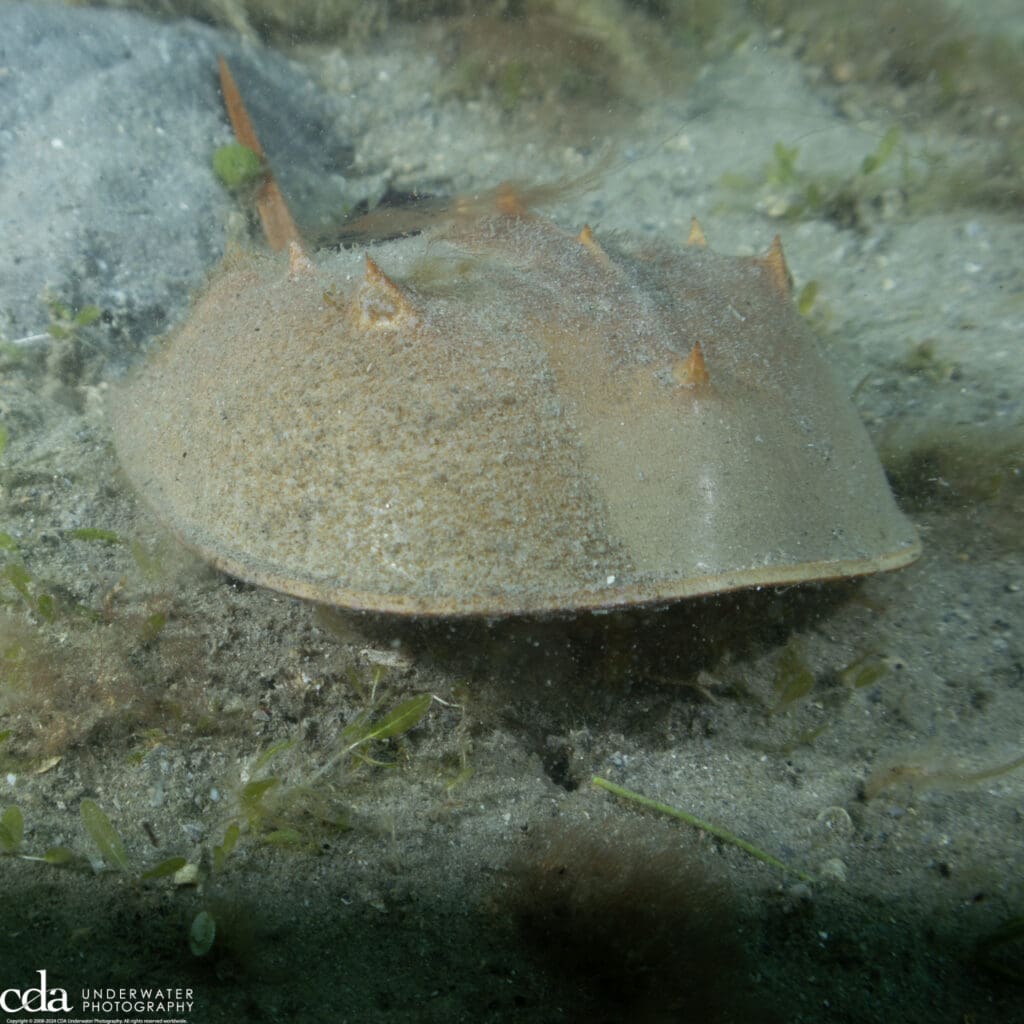
As a scuba diver, I’ve had the privilege of exploring some of South Florida’s most vibrant underwater ecosystems—from coral reefs teeming with angelfish to seagrass beds where manatees graze like underwater cows. But one of the most surreal encounters I’ve had was with a creature that looked like it had crawled straight out of a prehistoric textbook: the Horseshoe Crab (Limulus polyphemus).
You don’t always expect to see them on a dive. They’re not flashy like a spotted eagle ray or elusive like a nurse shark. But if you’re drifting slowly over a sandy bottom or exploring a quiet estuary near the mangroves, you might spot one half-buried in the sediment, its domed shell blending perfectly with the sea floor. At first glance, it looks like a rusted helmet or a forgotten relic. Then it moves—slowly, deliberately—and you realize you’re looking at one of Earth’s oldest living species.
Despite the name, the horseshoe crab isn’t a crab at all. It’s more closely related to spiders and scorpions than to any crustacean. Its body is divided into three parts: the rounded carapace, the abdominal section, and a long, rigid tail called a telson. That tail isn’t dangerous—it’s a tool the crab uses to flip itself over if it gets stuck. Watching one do this underwater is oddly graceful, like a slow-motion somersault.
Horseshoe crabs have a surprising total of 10 eyes, scattered all over their bodies. They have two large compound eyes on the sides of their shell, which are great for spotting mates during breeding season. On top of their shell, they’ve got several simple eyes—some detect visible and ultraviolet light, while others help regulate their internal clock based on light cycles. There are also light sensors on their tail and two ventral eyes near their mouth, which help with orientation while swimming. Despite all these eyes, their vision is pretty basic—mostly used to sense light and movement.
In South Florida, horseshoe crabs tend to hang out in shallow coastal waters, especially in areas with soft, muddy or sandy bottoms. I’ve seen them near the Intracoastal Waterway, in the waters of Blue Heron Bridge, and around the mangrove fringes of the Ten Thousand Islands. They’re most active during spawning season, which usually aligns with the full and new moons in spring and fall. If you’re diving during those times, you might witness a small congregation of them—males clinging to the backs of larger females as they search for a place to lay eggs.
Underwater, their movements are slow and deliberate. They use their legs to stir up the sediment, searching for food. Horseshoe crabs are scavengers, feeding on worms, small mollusks, algae, and detritus. I’ve watched one methodically sift through the sand, its legs working like little rakes. It’s not a thrilling sight, but it’s oddly meditative—like watching nature’s janitor quietly clean up the ocean floor.
And they’re not just cleaning up. Horseshoe crabs play a vital role in the ecosystem. Their eggs, laid in massive numbers on beaches, are a critical food source for migratory birds like the red knot. These birds time their long journeys to coincide with horseshoe crab spawning, relying on the nutrient-rich eggs to fuel their flights. Underwater, the crabs themselves provide food for fish and sea turtles, and their burrowing helps aerate the sediment, supporting other bottom-dwelling organisms.
But here’s where things get complicated. Horseshoe crabs are also harvested commercially. As a diver and conservationist, this part always gives me pause. In Florida, they’re collected for bait in eel and whelk fisheries, and more significantly, for biomedical purposes. Their blood—yes, blood—is bright blue and contains a compound called Limulus amebocyte lysate (LAL), which is used to test for bacterial contamination in medical equipment and vaccines. If you’ve ever had a shot or surgery, you’ve benefited from the horseshoe crab’s unique biology.
The blood is extracted in labs, and the crabs are usually returned to the wild. But not all survive the process, and some show signs of stress or disorientation afterward. As a diver, I’ve seen crabs that seem sluggish or off-kilter, and I can’t help but wonder if they’ve been through the bleeding process. There’s ongoing research into synthetic alternatives to LAL, but adoption has been slow.
Florida’s fishery is regulated, and there are citizen science programs like the Florida Horseshoe Crab Watch that help monitor populations. Divers can contribute too—by logging sightings, reporting spawning activity, and advocating for habitat protection. These creatures take nearly a decade to reach maturity, so every individual counts.
Diving with horseshoe crabs isn’t like swimming with dolphins or photographing a reef shark. It’s quieter, more reflective. You’re sharing space with a creature that predates the dinosaurs, that’s survived mass extinctions and shifting continents. It’s humbling. And it’s a reminder that not all marine life is flashy or fast—some of it is ancient, deliberate, and quietly essential.
So next time you’re diving in South Florida, keep an eye on the sand. Look for that telltale horseshoe shape, the slow crawl, the flick of a tail. You might just find yourself face-to-face with one of nature’s oldest stories.
Photograph courtesy of Christopher Duncan, Copyright 2025 CDA Underwater Photography, all rights reserved worldwide. Some textual content generated with AI.