

It’s Friday, so it must be time for another #fff, friday fish fact.
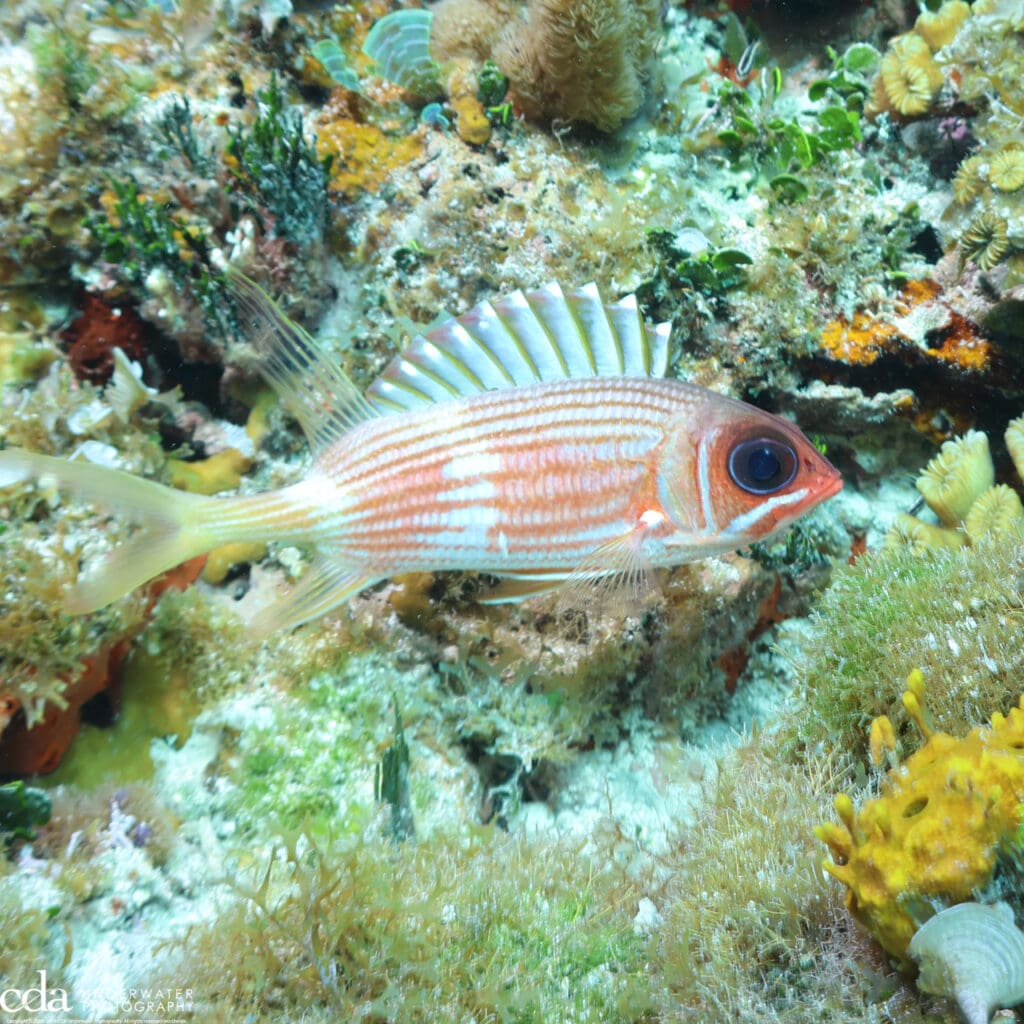
The Longspine Squirrelfish (Holocentrus rufus) stands out based solely on its appearance. This fish always looks like it just woke up, is grumpy about it, and has a bad case of bed hair due to its vivid coloration, oversized eyes, and spiny dorsal fin. This nocturnal reef dweller is not only a pretty fish but also plays a unique role in the reef ecosystem. Found throughout the western Atlantic, including the Caribbean Sea and the Gulf of Mexico, the Longspine Squirrelfish is a fascinating species with a story written in its stripes, spines, and secretive habits.
In South Florida, the Longspine Squirrelfish is one of the most frequently encountered squirrelfish species on coral reefs. According to Florent’s Guide to the South Florida Reefs, there are multiple species of squirrelfish in our waters like the Longjaw Squirrelfish and Dusky Squirrelfish, but the Longspine is particularly common due to its broad habitat range and adaptability.
Divers and snorkelers in the Florida Keys and surrounding reef systems often report sightings of Longspine Squirrelfish, especially during night dives when they emerge from their daytime shelters to forage.
Why Does It Look Like That?
The Longspine Squirrelfish is instantly recognizable thanks to its bright red body, white horizontal stripes, and large, reflective eyes. These features are not just for show—they serve specific evolutionary purposes:
- Coloration: The red hue of the squirrelfish is a form of camouflage in the deep or dimly lit reef environments. Red light is absorbed quickly underwater, making red-colored animals nearly invisible at depth or at night.
- Large Eyes: Adapted for nocturnal activity, the squirrelfish’s eyes are proportionally large to maximize light intake in low-light conditions. This allows it to hunt and navigate effectively after dark.
- Long Dorsal Spines: The elongated spines on its dorsal fin are a defense mechanism. When threatened, the fish can raise these spines to deter predators or wedge itself into crevices to avoid being pulled out.
These adaptations make the Longspine Squirrelfish a master of its nighttime domain, blending stealth, defense, and sensory acuity.
One of the easy ways to differentiate the Longspine Squirrelfish from others is the presence of white triangles at the tip of each of its dorsal spines.
What Does It Eat?
As a nocturnal carnivore, the Longspine Squirrelfish emerges from its daytime hiding spots at dusk to forage. Its diet primarily consists of:
- Small crustaceans such as shrimp and crabs
- Polychaete worms
- Small fish
- Zooplankton
Using its keen eyesight, it hunts along the reef floor and among coral branches, often alone or in small groups. Its feeding behavior helps control populations of small invertebrates, contributing to the ecological balance of the reef.
Where Does It Live?
It prefers shallow to moderately deep coral reefs, typically between 3 to 100 meters in depth. During the day, it hides in caves, crevices, and under ledges, often in groups. These hiding spots offer protection from predators and the bright sunlight, which is not ideal for its sensitive eyes.
How Does It React to Divers?
The Longspine Squirrelfish is generally shy and reclusive during the day. Divers who approach too closely may see it retreat deeper into its hiding spot. However, it is not particularly fast or aggressive, and with a calm approach, it can be observed without causing it distress.
At night, the behavior changes. Divers using underwater lights may spot squirrelfish actively swimming and foraging. The light often reflects off their large eyes, making them easier to spot. Despite their nocturnal activity, they remain cautious and will dart away if they feel threatened.
When Is the Best Time to Find Them?
The best time to observe Longspine Squirrelfish is during night dives. As nocturnal creatures, they are most active after sunset, emerging from their shelters to hunt. Night diving in tropical reef environments offers a unique opportunity to see these fish in action, along with many other nocturnal reef dwellers.
If night diving isn’t an option, they can still be seen during the day by carefully inspecting shaded reef areas, overhangs, and caves. A flashlight can help spot them tucked away in their hiding spots.