

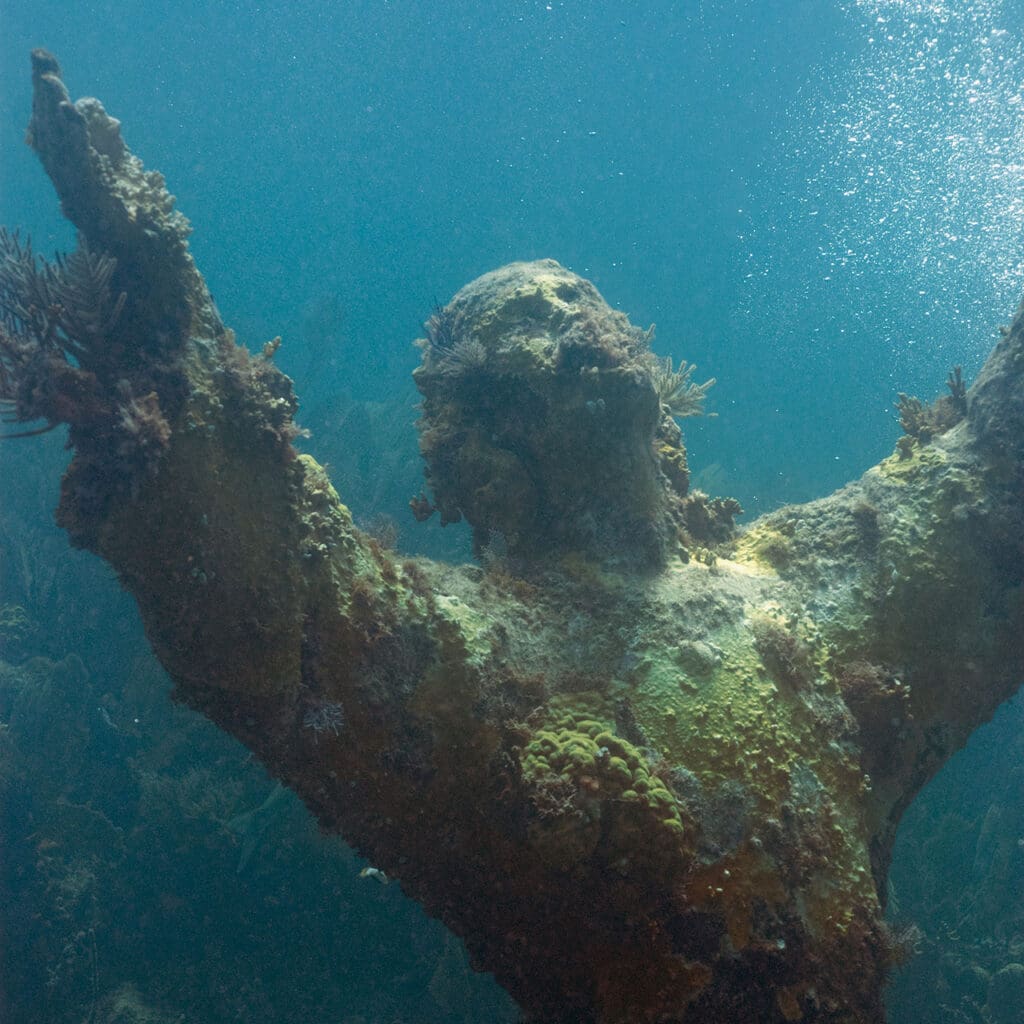
Key Largo is considered the gateway to the Florida Keys, and you can’t drive down US 1 without seeing a dive operator every 50 feet. With John Pennekamp State Park just offshore, it is truly magical. It’s a place where the sea seems to whisper secrets to the mangroves, and the sunsets look like they were painted by a tipsy angel with a fondness for coral pink.
But tucked just offshore, in waters so clear they make a glass-bottom boat blush, lies one of the most curious and beloved landmarks in all the Keys: the Christ of the Abyss statue.
How It Got There
Back in the summer of 1965, a nine-foot-tall bronze statue of Jesus Christ was gently lowered into the sea near a reef called Dry Rocks, just off John Pennekamp Coral Reef State Park. This wasn’t some random art drop—it was the third casting of a statue originally sculpted by Italian artist Guido Galletti. The idea came from a diver named Duilio Marcante, who wanted to honor his friend Dario Gonzatti, the first Italian to use scuba gear, who tragically died during a dive in 1947.
The original statue, called Il Cristo degli Abissi, was placed in the Mediterranean Sea near San Fruttuoso, Italy, in 1954. A second casting went to Grenada in 1961, as a thank-you from Italy for rescuing the crew of a sinking ship. And the third? That one was gifted by Egidio Cressi, a bigwig in the Italian dive gear world, to the Underwater Society of America.
After a bit of a road trip—Chicago to Orlando, with a few pit stops—the statue finally made its way to Key Largo. It was bolted to a 20-ton concrete base, and on August 25, 1965, it was gently sunk into 25 feet of water, arms raised toward the surface like it was blessing the reef and all who swam by.
Why It’s There
Folks say the statue is a symbol of peace, hope, and remembrance. It’s a tribute to those lost at sea and a nod to the brave souls who explore the ocean’s depths. But it’s also a bit of a spiritual lighthouse—something that makes divers pause, reflect, and maybe whisper a little prayer through their regulator.
And let’s be honest: it’s also a heck of a photo op.
Storms, Hurricanes, and the Test of Time
Now, you might be wondering how a statue like that holds up when Mother Nature throws a tantrum. Turns out, it’s tougher than a conch shell in a blender.
When Hurricane Irma barreled through in 2017, she kicked up sand, snapped sea fans, and rearranged coral like a toddler with a toy box. But the Christ of the Abyss? He stood firm, arms still outstretched, looking like he’d just shrugged and said, “Is that all you got?”.
Divers checked on him afterward and found him unscathed. Even the massive brain coral nearby was still hanging in there. That concrete base—42,000 pounds of it—keeps him anchored like a stubborn old fisherman who refuses to leave his dock.
What’s Growing on Him?
After nearly six decades underwater, the statue’s taken on a bit of a sea-swept look. He’s got patches of fire coral, algae, and maybe a few barnacles hitching a ride. It’s like he’s wearing a robe stitched by the ocean itself.
Fire coral, by the way, is a sneaky little critter. It looks soft and fuzzy, but touch it and you’ll feel like you’ve high-fived a jellyfish. So while divers can swim right up to the statue—and many do—it’s best to admire from a respectful distance unless you want a stinging souvenir.
Can You Touch It?
Technically, yes. The statue’s reachable by scuba divers, and even snorkelers can see it from the surface. But touching it? That’s a bit of a gray area.
The Florida Keys National Marine Sanctuary, where the statue now resides, encourages folks to look but not touch. Not just because of the fire coral, but because every little poke and prod can wear down the bronze and disturb the marine life that’s made the statue its home.
Besides, there’s something kind of sacred about leaving it be. Like visiting a cathedral—you don’t climb the altar, you just sit quietly and soak it in.
A Place for Love and Wonder
Over the years, the Christ of the Abyss has seen more than just fish and flippers. Couples have gotten married beside it, divers have proposed in its shadow, and countless folks have found a moment of peace beneath its gaze.
It’s not just a statue. It’s a story. A memory. A reminder that even in the deep, there’s light.
So, if you ever find yourself in Key Largo, grab a tank, hop on a boat, and head out to Dry Rocks. Drift down through the warm, clear water, past the parrotfish and the coral fingers, and you’ll see him—arms raised, eyes lifted, waiting.
And maybe, just maybe, you’ll feel a little blessed yourself.
Some text content created with generative AI and then edited. Photograph courtesy Christopher Duncan, copyright 2025 CDA Underwater Photography. All rights reserved worldwide.