

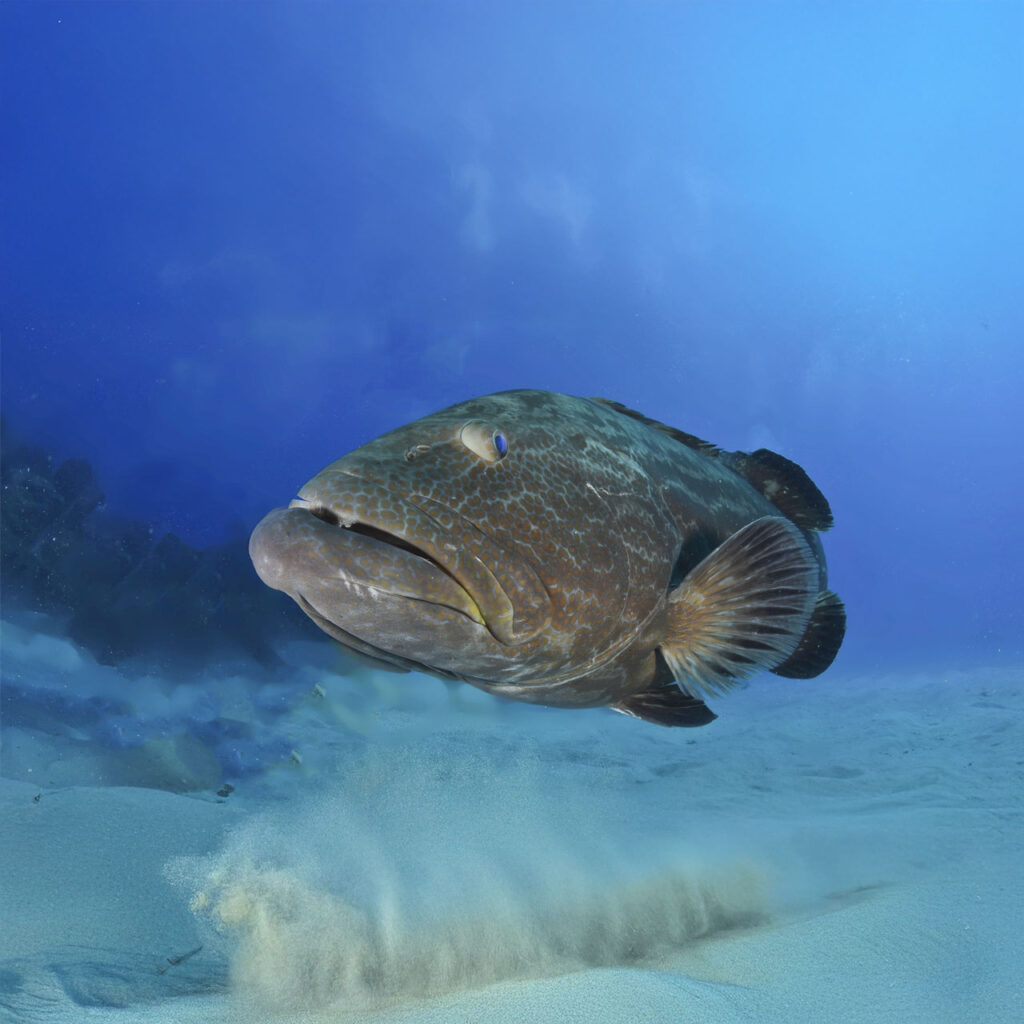
The Reef’s Heavyweight with a Secretive Side
If the reef had a bouncer, it would be the Black Grouper (Mycteroperca bonaci). Big, bold, and built like a submarine, this fish commands respect without saying a word. It’s the kind of creature that lurks in the shadows, waiting for the perfect moment to strike—an apex ambush predator with a flair for stealth and a face that says, “I own this ledge.”
Meet the Black Grouper
The Black Grouper is one of the largest reef fish in the western Atlantic, often reaching 4 feet in length and tipping the scales at over 100 pounds. Its body is robust, its mouth cavernous, and its coloration a masterclass in camouflage: dark gray to olive with irregular blotches that melt into the reefscape.
Identification cues:
- Body: Thick, muscular, with a squared-off tail.
- Color: Dark gray, olive, or brown with blotchy patterns.
- Head: Large, sloping forehead and a mouth that looks like it could swallow a football.
- Behavior: Solitary, territorial, and fond of deep ledges.
Lifestyle and Diet
Black Groupers are ambush predators, the strong, silent hunters of the reef. They position themselves near ledges, caves, and wrecks, waiting for unsuspecting prey to wander by. When the moment is right, they strike with lightning speed, inhaling fish and crustaceans in a single gulp.
Their menu includes:
- Snapper and grunts (reef fish that make easy targets).
- Crustaceans like crabs and lobsters.
- Occasionally, smaller groupers—because why not?
Behavior That Impresses
- Hovering near cleaning stations: Black Groupers often visit wrasses and gobies for parasite removal, hovering like VIPs at a spa.
- Color shifts: They can subtly change shades to blend better with surroundings.
- Curiosity: While generally shy, large individuals sometimes approach divers slowly, as if inspecting their credentials.
Distribution in South Florida
Black Groupers are common throughout South Florida, especially:
- Florida Keys: Deep reef ledges and spur-and-groove formations.
- Broward and Palm Beach: Artificial reefs and wrecks in 60–100 feet of water.
- Seasonality: More active and visible during cooler months when water clarity improves.
Look for them:
- Near drop-offs and caves.
- On wrecks like the Spiegel Grove or Duane in Key Largo.
- Around cleaning stations, where smaller fish swarm their massive frame.
Cozumel Cameo
Cozumel’s dramatic walls are prime Black Grouper territory. Sites like:
- Santa Rosa Wall and Palancar Reef: Expect to see them lurking under ledges or cruising the blue.
- Colombia Deep: A hotspot for big predators, including hefty groupers.
- Tormentos Reef: Known for strong currents and large fish sightings.
In Cozumel, Black Groupers often pose for photographers—if you’re patient. Approach slowly, maintain neutral buoyancy, and let them decide if you’re worthy of a close-up.
Conservation Status
While not as critically endangered as Nassau Grouper, Black Groupers face pressure from:
- Overfishing, especially during spawning aggregations.
- Habitat degradation from reef damage and pollution.
- Bycatch in commercial fisheries.
What divers can do:
- Support catch limits and seasonal closures.
- Avoid spearfishing in protected areas.
- Advocate for reef conservation—healthy reefs mean healthy groupers.
Quick Facts
- Species: Mycteroperca bonaci
- Size: Up to 4 feet, 100+ pounds
- Diet: Fish and crustaceans
- Habitat: Deep reefs, ledges, wrecks
- Role: Apex predator, reef regulator
Where to Spot Them
- South Florida: Florida Keys deep reefs, Broward/Palm Beach wrecks.
- Cozumel: Santa Rosa Wall, Palancar Reef, Colombia Deep.
Photography Tips
- Use a wide-angle lens for full-body shots.
- Approach slowly from the side—never chase.
- Natural light works well in clear water; strobes help at depth.
Black Groupers are the reef’s silent enforcers—powerful, elusive, and endlessly fascinating. Every encounter feels like meeting the ocean’s strongman, a reminder that reefs thrive when their top predators keep the balance.
Content created by Gen AI but edited by scuba divers for scuba divers. Image courtesy of Albert kok, CC BY-SA 4.0, via Wikimedia Commons
