

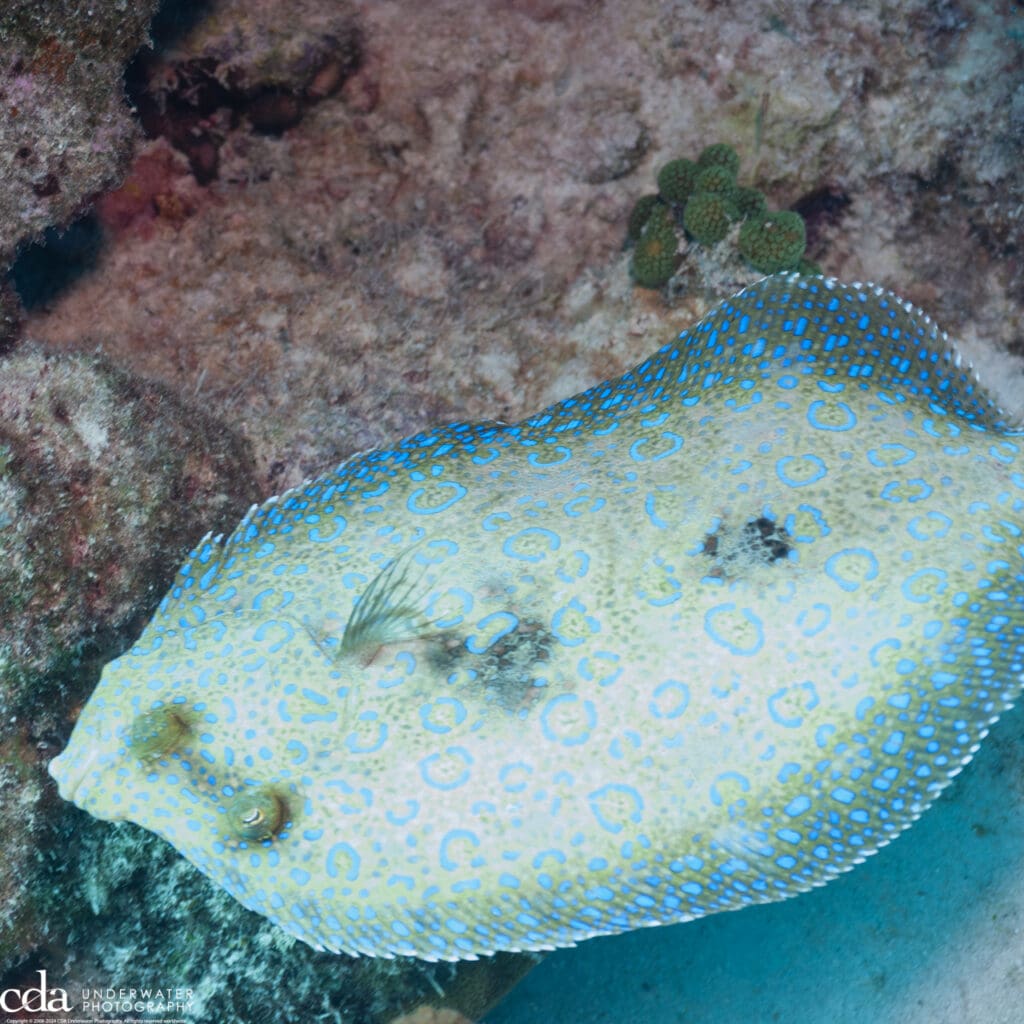
The Peacock Flounder (Bothus lunatus) is one of the ocean’s most captivating illusionists. With its flattened body, dazzling eye-spots, and uncanny ability to vanish into the sand, this flatfish is a true master of camouflage. Found throughout South Florida’s coastal waters, it’s a favorite among divers who enjoy the thrill of spotting hidden creatures in plain sight.
This fish doesn’t just blend in—it transforms. Its ability to change color and pattern in seconds makes it one of the most effective ambush predators on the reef. Whether lying motionless on a sandy bottom or gliding across a seagrass bed, the Peacock Flounder is a living example of evolutionary artistry.
Fun Fact First
Peacock Flounders are among the fastest color-changers in the ocean. They can shift their skin tone and pattern in just a few seconds, adapting to sand, coral, rock, or seagrass with stunning precision. This ability is controlled by specialized skin cells called chromatophores, which expand or contract to alter pigmentation.
Their camouflage is so effective that divers often swim right over them without noticing. Only when the flounder moves—or when its eyes catch the light—does its presence become apparent. It’s not uncommon for a diver to be startled when what looked like a patch of sand suddenly swims away.
This color-shifting ability isn’t just for hiding—it’s also used for communication and intimidation. When threatened, a Peacock Flounder may flash brighter colors to confuse or deter predators.
Where to Find Them
Peacock Flounders are found in sandy flats, seagrass beds, and along the edges of coral reefs throughout South Florida, including the Florida Keys, Biscayne Bay, and offshore reefs near Fort Lauderdale and Miami. They prefer areas with mixed substrate, where they can blend in and lie in wait for unsuspecting prey.
They’re most active during the day, often seen lying motionless on the bottom. Their flat bodies allow them to settle flush against the substrate, making them nearly invisible. Look closely at patches of sand with subtle eye-like markings or slight movement—chances are, you’ve found a flounder.
Peacock Flounders are also known to inhabit shallow lagoons, channels, and nearshore reef zones, especially where the current is mild and visibility is good. Their preference for transitional habitats makes them a common sight for snorkelers and shore divers.
Habits and Behavior
Peacock Flounders are ambush predators, relying on stealth and surprise to catch their prey. They lie in wait, buried in the sand with only their eyes exposed, watching for small fish, shrimp, or crabs to pass by. When the moment is right, they strike with lightning speed, using their powerful jaws to snatch prey before it can escape.
Their flattened bodies are perfectly adapted for this lifestyle. Unlike most fish, flounders undergo a metamorphosis during development—starting life with eyes on both sides of their head, then shifting one eye to the opposite side as they mature. This results in both eyes being on the top side of their body, allowing them to see while lying flat on the ocean floor.
Peacock Flounders also exhibit a unique form of locomotion. They swim sideways, using an undulating motion that resembles a ripple across the sand. This movement is both graceful and slightly eerie, adding to their mystique.
When disturbed, they may dart away in a burst of speed, only to settle a few feet away and vanish once again into the substrate. Their ability to disappear and reappear makes them a favorite among underwater photographers and marine life enthusiasts.
What They Eat (and Who Eats Them)
Peacock Flounders are carnivorous, feeding on small fish, shrimp, crabs, and other benthic invertebrates. Their hunting strategy is based on patience and precision—they wait for prey to come close, then strike with a rapid lunge.
Their diet helps maintain the balance of reef ecosystems by controlling populations of small, fast-reproducing species. They’re part of the reef’s natural predator-prey cycle, contributing to biodiversity and ecological stability.
Despite their camouflage, Peacock Flounders do have predators. Larger fish, such as groupers, snappers, and barracudas, may prey on them, especially juveniles. Rays and sharks are also potential threats. However, their ability to blend in and escape quickly makes them a challenging target.
Their coloration and behavior are their primary defenses. By remaining motionless and matching their surroundings, they avoid detection. If spotted, they rely on speed and agility to escape, often leaving behind a cloud of sand to confuse their pursuer.
Why They’re Interesting
Peacock Flounders are a textbook example of adaptation. Their body structure, behavior, and camouflage abilities are all finely tuned for survival in a complex and competitive environment. They’ve evolved to be invisible, efficient, and surprisingly elegant.
From a scientific perspective, they’re fascinating. Their metamorphosis—from symmetrical larvae to asymmetrical adults—is a rare and dramatic transformation. This shift allows them to live a benthic lifestyle, lying flat on the ocean floor with both eyes facing upward.
Their camouflage is also a subject of ongoing research. Scientists study their chromatophores to better understand how animals control color and pattern. These insights have applications in fields ranging from biology to materials science.
For divers, Peacock Flounders offer a rewarding challenge. Spotting one requires patience, attention to detail, and a keen eye for subtle movement. Once found, they’re a joy to observe—graceful, mysterious, and undeniably beautiful.
They’re also a reminder of the ocean’s complexity. In a world full of bright colors and bold behaviors, the flounder thrives by being quiet, hidden, and perfectly adapted to its niche.
Tips for Divers
If you’re hoping to spot a Peacock Flounder, here are a few tips:
- Scan the sand: Look for eye-like markings or slight movement.
- Approach slowly: Sudden motion may cause them to flee.
- Use natural light: Their camouflage is most visible under ambient conditions.
- Watch for movement: Their sideways swimming is distinctive and easy to recognize.
They’re most active during the day and often found near reef edges or in sandy patches between coral heads. Sites like Molasses Reef, Looe Key, and Lauderdale-by-the-Sea are great places to look.
Final Thoughts
The Peacock Flounder is more than just a flatfish—it’s a living work of art. Its ability to vanish into the sand, change color in seconds, and strike with precision makes it one of the reef’s most fascinating residents.
Whether you’re a seasoned diver or just starting out, spotting a Peacock Flounder is a memorable experience. It challenges your perception, rewards your patience, and deepens your appreciation for the subtle wonders of the underwater world.
So next time you’re exploring South Florida’s reefs or sandy flats, take a moment to look closely. The ocean’s best disguises are often hiding in plain sight—and the Peacock Flounder is the master of them all.
Content created by Gen AI but edited by scuba divers for scuba divers. Image courtesy of Christopher Duncan, copyright 2025 CDA Underwater Photography, all rights reserved worldwide.