

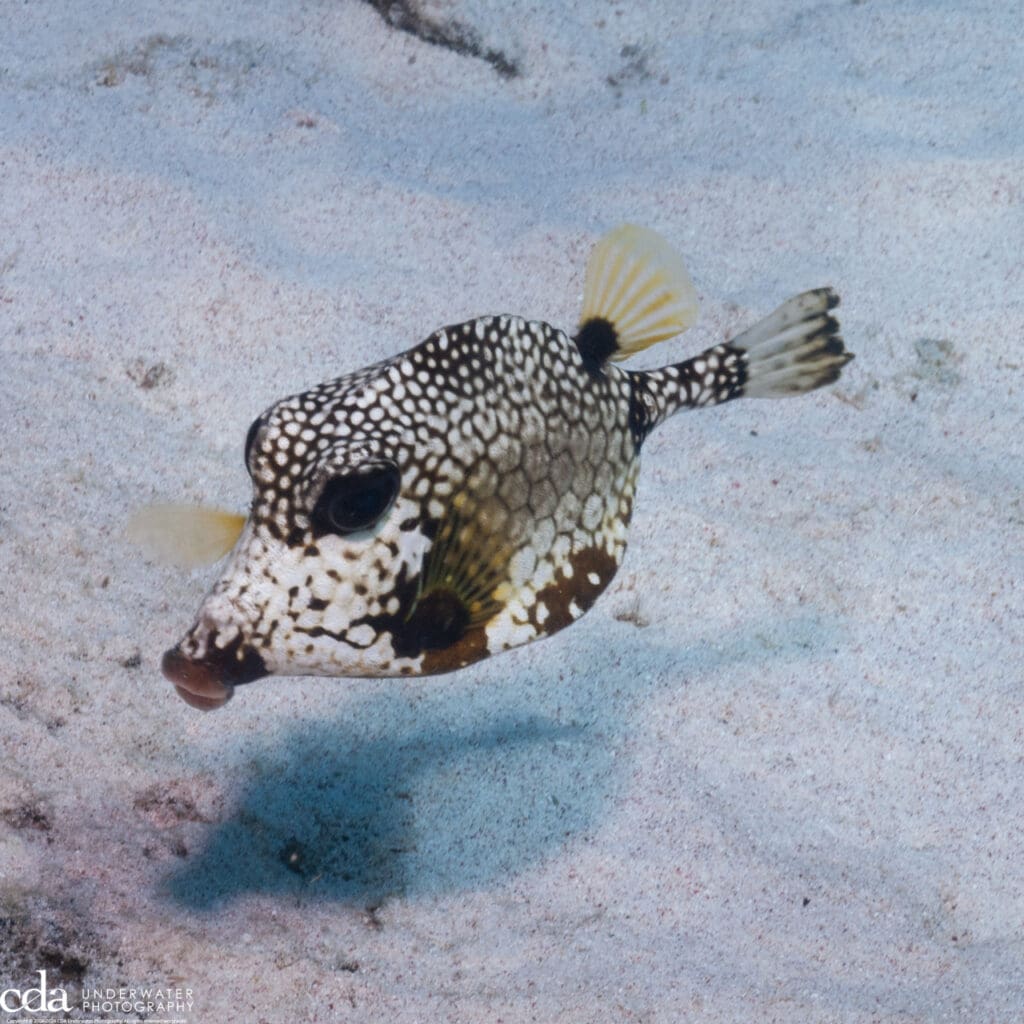
The Honeycomb Cowfish (Acanthostracion polygonius) is one of the quirkiest and most visually striking fish you’ll encounter on a South Florida reef. With its hexagonal-patterned body, boxy shape, and slow, deliberate movements, it looks like a creature designed by a steampunk artist. Its rigid, armor-like body gives it a mechanical appearance, and its behavior only adds to the intrigue.
This fish isn’t just a visual oddity—it’s a marvel of evolutionary adaptation. From its bony plating to its defensive mucus and curious feeding habits, the Honeycomb Cowfish is a standout species that captures the attention of divers, snorkelers, and marine biologists alike.
Fun Fact First
Unlike most reef fish, the Honeycomb Cowfish doesn’t have scales. Instead, it’s covered in bony plates that form a rigid, box-like carapace around its body. This armor makes it a slow swimmer, but also a tough target for predators. Its body is essentially a hard shell with only the fins, mouth, and tail protruding.
But the cowfish’s defenses don’t stop there. When stressed or threatened, it can release a toxic mucus into the water. This substance, known as ostracitoxin, can deter predators and even harm nearby fish if released in high concentrations. It’s a last-resort defense mechanism that underscores just how well-equipped this fish is for survival.
Despite its tough exterior, the Honeycomb Cowfish is generally peaceful and solitary. It’s more likely to retreat than confront, relying on its armor and toxins to discourage any would-be attackers.
Where to Find Them
Honeycomb Cowfish are found throughout South Florida, especially in coral reefs, seagrass beds, and sandy flats. They prefer calm, shallow waters, often lingering near coral heads, rubble zones, or patches of seagrass where they can forage undisturbed.
They’re most commonly seen in areas like the Florida Keys, Biscayne National Park, and offshore reefs near Fort Lauderdale and Miami. Because they move slowly and tend to stay close to the bottom, they’re relatively easy to spot—especially for patient divers and snorkelers.
These fish are solitary by nature, usually seen alone or in pairs. They don’t form schools and tend to maintain a slow, deliberate pace as they explore their surroundings. Their unique shape and coloration make them easy to identify, even from a distance.
Habits and Behavior
The Honeycomb Cowfish is a slow and deliberate swimmer, using its tiny pectoral fins to maneuver with surprising precision. Its rigid body prevents it from making sharp turns or quick escapes, so it relies on stealth and camouflage to avoid trouble.
One of its most fascinating behaviors is its feeding technique. Cowfish feed by blowing jets of water into the sand, uncovering hidden prey like worms, crustaceans, and small invertebrates. Once exposed, the prey is sucked up through the cowfish’s tube-like mouth, which acts like a vacuum.
This feeding method is not only effective but also entertaining to watch. Divers often observe cowfish hovering over the sand, puffing out bursts of water and then darting forward to slurp up whatever emerges.
Another remarkable trait is their ability to change color. Honeycomb Cowfish can shift their hues to better blend into their surroundings, helping them avoid detection by predators. This color-changing ability is subtle but effective, allowing them to match the tones of coral, sand, or seagrass depending on their location.
What They Eat (and Who Eats Them)
Honeycomb Cowfish are opportunistic feeders, dining on a variety of small invertebrates, worms, mollusks, and crustaceans. Their feeding strategy—blowing water to uncover prey—is particularly useful in sandy or rubble-strewn environments where food may be hidden beneath the surface.
Their diet helps maintain the health of reef ecosystems by controlling populations of small benthic organisms. They’re part of the reef’s natural cleaning crew, keeping the substrate active and balanced.
As for predators, the cowfish’s armor and toxic mucus make it a less appealing target. Most reef predators avoid them, but large groupers, sharks, and barracudas may still take a chance if food is scarce. However, the risk of ingesting ostracitoxin often outweighs the reward, making cowfish a relatively safe species in the reef hierarchy.
Interestingly, their toxin is not just a defense—it can be a danger to other fish in confined spaces. In aquariums, cowfish must be handled with care, as a stressed individual can release enough toxin to harm tankmates.
Why They’re Interesting
The Honeycomb Cowfish stands out for a number of reasons. Its armor-like body, toxic defense, and unusual feeding habits make it one of the most unique fish on the reef. But it’s not just its biology that fascinates—it’s also its personality.
Cowfish are known to be curious and observant, often approaching divers slowly and watching them with apparent interest. Their expressive eyes and deliberate movements give them a quirky charm that’s hard to resist. Many underwater photographers consider them a favorite subject due to their distinctive look and cooperative behavior.
Their hexagonal pattern, which resembles a honeycomb, is not just decorative—it’s part of their structural armor. This pattern helps distribute pressure across their body, making them more resilient to bites and bumps. It’s a brilliant example of form meeting function in marine evolution.
From a scientific perspective, cowfish are a great case study in defensive adaptation. They’ve traded speed for protection, relying on passive defenses rather than active escape. This strategy works well in the reef environment, where hiding and deterrence can be just as effective as fleeing.
Final Thoughts
The Honeycomb Cowfish may not be the fastest fish in the sea, but it’s certainly one of the most memorable. Its armored body, toxic defenses, and curious nature make it a standout species in South Florida’s underwater world.
Whether you’re a diver, snorkeler, or marine life enthusiast, spotting a cowfish is always a treat. They remind us that the ocean is full of surprises—and that sometimes, the oddballs are the most fascinating of all.
So next time you’re exploring a reef or drifting over a seagrass bed, keep an eye out for this armored oddball. With its honeycomb pattern and slow, deliberate movements, the Honeycomb Cowfish is a living reminder that nature doesn’t just build for speed—it builds for survival, style, and a little bit of whimsy.
Content created by Gen AI but edited by scuba divers for scuba divers. Image courtesy of Christopher Duncan, copyright 2025 CDA Underwater Photography, all rights reserved worldwide.