

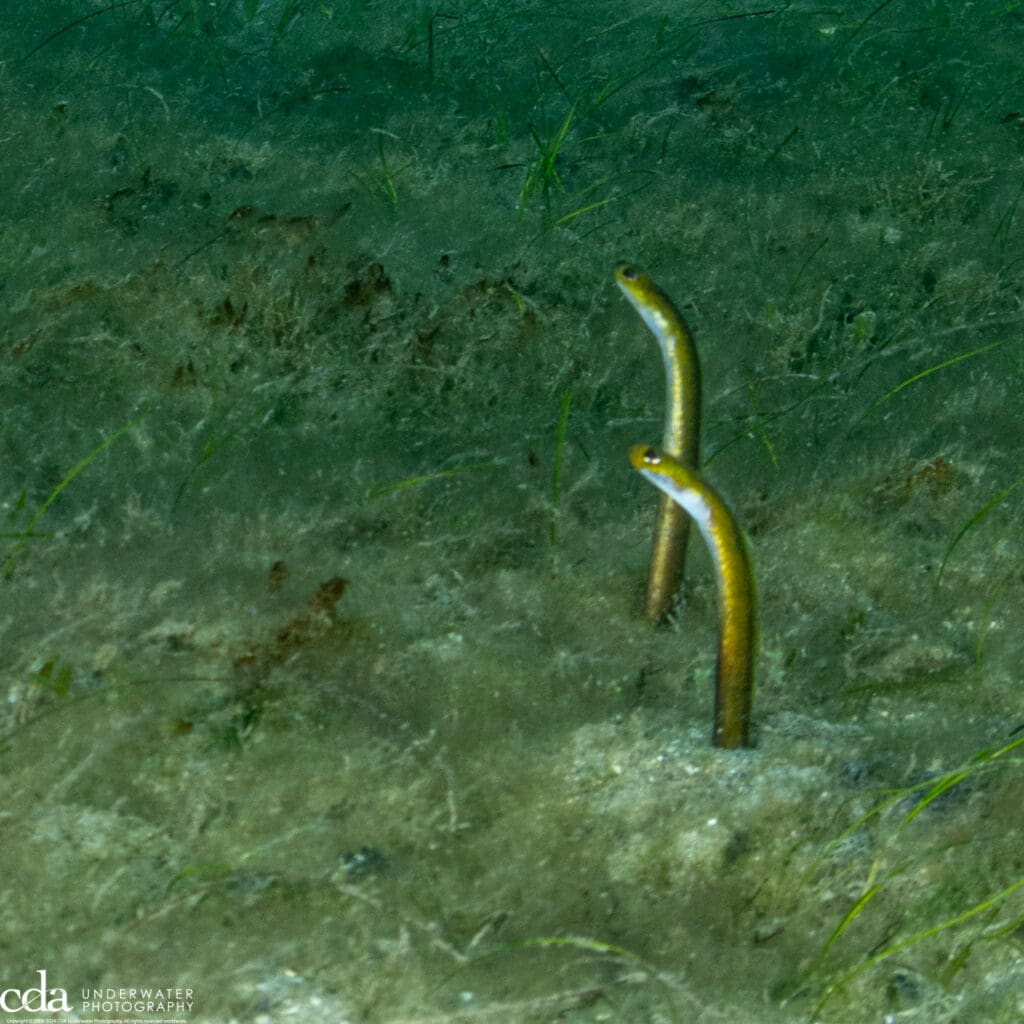
The Yellow Garden Eel (Heteroconger longissimus) is one of the most whimsical and captivating sights you’ll encounter on a dive in South Florida. Imagine drifting over a sandy flat and suddenly seeing a field of slender, yellowish eels poking out of the seabed, swaying gently in the current like underwater blades of grass. It’s mesmerizing, surreal, and oddly peaceful—like watching a living meadow beneath the waves.
Fun Fact First
These eels are masters of subtlety. They rarely leave their burrows and spend most of their lives half-buried in the sand. Living in colonies, they pop out just enough to feed, and if you approach too closely, they’ll vanish into the sand in an instant—like magic. Their retreat is so quick and synchronized that it often startles divers who weren’t expecting such a coordinated disappearing act.
Despite their shy nature, garden eels are a favorite among underwater photographers and marine life enthusiasts. Their behavior is predictable, their appearance is charming, and their colonies can stretch across large areas, creating a unique visual experience.
Where to Find Them
Yellow Garden Eels are typically found in sandy flats near coral reefs, especially near Blue Heron Bridge, in the Florida Keys and deeper offshore sites along the South Florida coast. They prefer areas with gentle currents and soft sediment, which allow them to dig and maintain their burrows.
You’re most likely to spot them during daylight hours, when they’re actively feeding. At night, they retreat fully into their burrows for safety. Look for them in areas just adjacent to reef structures, where the sand is undisturbed and the current brings a steady flow of plankton.
Habits and Behavior
These eels are colonial and shy, living in dense groups that can number in the hundreds. Each eel digs its own burrow in the sand and lines it with mucus to keep it stable. Their bodies are long, slender, and highly flexible—perfectly adapted for a life spent half-submerged.
They feed by facing into the current, extending their bodies from their burrows and snatching plankton and other tiny particles from the water. Their synchronized swaying isn’t just beautiful—it’s functional. It helps them stay upright, avoid tangling with neighbors, and maintain their position in the current.
Interestingly, garden eels rarely leave their burrows once they’ve settled. If they do, it’s usually to relocate to a better feeding spot or to escape a predator. They’re extremely sensitive to movement and vibration, which is why divers must approach slowly and calmly to observe them without causing a mass retreat.
What They Eat (and Who Eats Them)
Yellow Garden Eels are planktivores, feeding primarily on zooplankton, drifting organic particles, and tiny crustaceans. Their feeding strategy is passive—they rely on the current to bring food to them, rather than actively hunting.
Despite their cautious nature, they do have predators. Larger reef fish such as jacks, triggerfish, and groupers may attempt to snatch them from their burrows. However, their quick retreat and burrow depth make them difficult to catch. Their colonies also provide safety in numbers—many eyes and bodies reacting to threats at once.
Why They’re Interesting
The Yellow Garden Eel is a perfect example of how specialized adaptations allow marine species to thrive in niche environments. Their communal living, burrow behavior, and feeding strategy are all tailored to a very specific habitat—sandy flats with steady currents.
From a biological standpoint, they’re fascinating. Their burrow construction involves mucus secretion and sand manipulation, and their ability to remain anchored while feeding is a marvel of evolutionary engineering. They also exhibit territorial behavior, maintaining a specific distance from neighbors to avoid conflict and entanglement.
For divers and marine biologists, garden eels offer a glimpse into the complex social dynamics of reef ecosystems. Watching them sway in unison is not just visually stunning—it’s a reminder of the delicate balance that exists beneath the surface.
Tips for Divers
If you’re hoping to observe Yellow Garden Eels up close, here are a few tips:
- Approach slowly: Sudden movements will send them diving into their burrows.
- Stay low: Hovering close to the sand (without touching it) helps reduce your profile.
- Use natural light: Flash photography can startle them. Try ambient light or red filters.
- Look for colonies: Once you spot one eel, you’ll likely find dozens more nearby.
They’re most active during the day, especially in areas with mild current. Sites like Molasses Reef, Looe Key, and Sombrero Reef in the Florida Keys are known for garden eel colonies.
Conservation Notes
While garden eels aren’t currently endangered, their habitat is sensitive. Sediment disruption, anchor damage, and coastal development can impact the sandy flats they rely on. Responsible diving practices—like avoiding contact with the seabed and anchoring away from reef zones—help protect these unique creatures.
They also serve as indicators of reef health. A thriving garden eel colony suggests a stable current, clean sediment, and a healthy plankton supply—all signs of a balanced ecosystem.
Final Thoughts
The Yellow Garden Eel may not be the flashiest fish on the reef, but it’s certainly one of the most enchanting. Their gentle swaying, communal living, and quirky behavior make them a standout species in South Florida’s underwater world.
Whether you’re a seasoned diver or just starting out, taking a moment to observe these “swaying sentinels” is a rewarding experience. They remind us that beauty in the ocean isn’t always bold—it’s often subtle, rhythmic, and quietly magical.
Content created by Gen AI but edited by scuba divers for scuba divers. Image courtesy of Christopher Duncan, copyright 2025 CDA Underwater Photography, all rights reserved worldwide.