

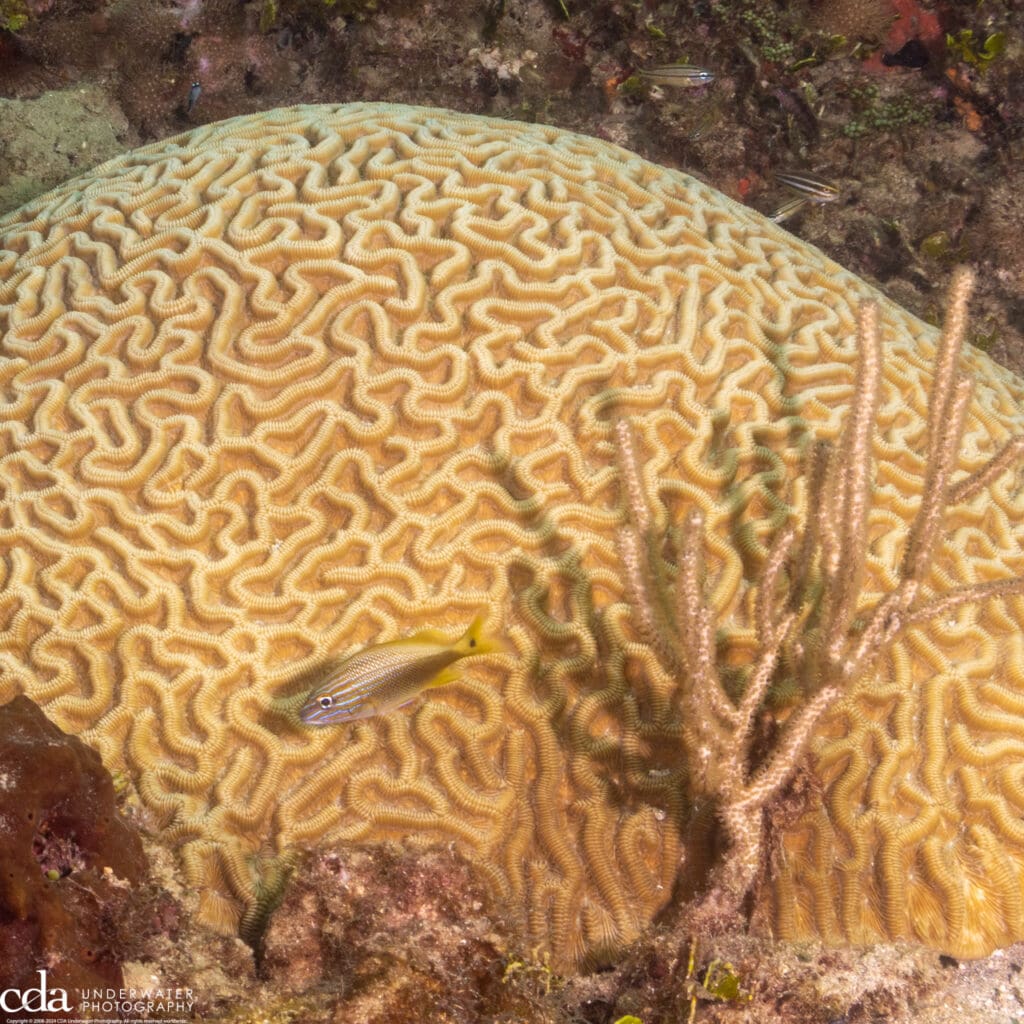
If you’ve ever been diving or snorkeling off the coast of South Florida and spotted a massive, dome-shaped coral that looks like a giant brain, you’ve likely encountered Symmetrical Brain Coral (Pseudodiploria strigosa). With its intricate maze-like ridges and valleys, it’s one of the most iconic and easily recognizable corals on the reef.
Fun Fact First:
Symmetrical Brain Coral gets its name from its perfectly grooved surface, which looks like the folds of a human brain. But here’s the kicker—it’s not just pretty. Those ridges are actually optimized for survival, helping the coral resist wave damage and channel water flow to maximize feeding and waste removal. Nature’s engineering at its finest.
Where to Find It in South Florida
Symmetrical Brain Coral is a common resident of shallow reefs throughout South Florida, especially in the Florida Keys National Marine Sanctuary, Biscayne National Park, and offshore patch reefs near Miami and Fort Lauderdale. It thrives in clear, warm waters between 3 to 40 feet deep, often forming large, rounded colonies that can grow several feet across.
You’ll usually find it nestled among other hard corals, often in areas with moderate wave action. Its sturdy structure makes it a reliable anchor point for reef fish and invertebrates seeking shelter.
Habits and Behavior
Despite its rock-like appearance, Symmetrical Brain Coral is very much alive. It’s made up of thousands of tiny polyps, each one a miniature animal that extends its tentacles at night to feed. During the day, the polyps retract into the coral’s hard skeleton, giving it that smooth, solid look.
These corals are colonial organisms, meaning all the polyps in a single colony are genetically identical and work together to build the massive calcium carbonate skeleton that gives the coral its shape.
One of the most fascinating things about Symmetrical Brain Coral is its longevity. Some colonies are estimated to be hundreds of years old, growing just a few millimeters per year. That means the coral you’re admiring on your dive might have been around since before the United States was founded.
What It Eats (and Who Eats It)
Symmetrical Brain Coral has a dual feeding strategy:
- Photosynthesis: Like many reef-building corals, it has a symbiotic relationship with zooxanthellae, microscopic algae that live inside its tissues. These algae use sunlight to produce energy, which they share with the coral in exchange for shelter and nutrients.
- Plankton Capture: At night, the coral’s polyps extend their tentacles to catch zooplankton and organic particles drifting in the water. It’s a slow, passive process, but it supplements the energy they get from photosynthesis.
As for predators, Symmetrical Brain Coral is relatively well-defended thanks to its hard skeleton. However, it’s not immune. Corallivorous snails, fireworms, and parrotfish are known to nibble on its tissue. In some cases, coral bleaching and disease (like white plague or black band disease) can also weaken or kill colonies.
What Makes It So Interesting?
There’s a lot to love about Symmetrical Brain Coral, but here are a few standout traits:
- Wave Resistance: Its dome shape and deep grooves help it withstand strong currents and wave action better than many other coral species.
- Water Channeling: The ridges help direct water flow, which improves feeding efficiency and waste removal.
- Reef Building: It’s a major contributor to reef structure, providing habitat for countless marine species.
- Climate Indicator: Because it grows slowly and records environmental conditions in its skeleton, scientists use it to study climate change and ocean chemistry over time.
Reproduction and Growth
Symmetrical Brain Coral reproduces both sexually and asexually:
- Sexual Reproduction: Like many corals, it participates in mass spawning events, usually in late summer. During these events, colonies release eggs and sperm into the water column, where fertilization occurs. The resulting larvae drift with the currents before settling on a suitable surface to start a new colony.
- Asexual Reproduction: It can also grow through fragmentation, where a piece of the coral breaks off and forms a new colony. This is especially useful in reef restoration projects.
Growth is slow—typically 1 to 3 centimeters per year—but steady. Over decades or centuries, a single colony can become a massive, dome-shaped structure that supports an entire micro-ecosystem.
Who Lives Around It?
Symmetrical Brain Coral isn’t just a pretty face—it’s a hub of biodiversity. Its ridges and crevices provide shelter for:
- Juvenile fish like damselfish and gobies
- Shrimp and crabs that hide from predators
- Sponges and tunicates that attach to its surface
- Algae and encrusting organisms that grow in its grooves
It’s also a favorite hangout for cleaner shrimp, which set up shop in the coral’s crevices and offer parasite-removal services to passing fish.
Threats and Conservation
Like many reef-building corals, Symmetrical Brain Coral faces a number of threats:
- Coral Bleaching: Rising sea temperatures can stress the coral and cause it to expel its zooxanthellae, turning it white and weakening it.
- Ocean Acidification: Increased CO₂ levels reduce the availability of calcium carbonate, making it harder for corals to build their skeletons.
- Pollution and Sedimentation: Runoff from land can smother coral colonies and block sunlight.
- Disease: Coral diseases like white plague and black band disease can spread rapidly and devastate colonies.
Fortunately, Symmetrical Brain Coral is a target species for reef restoration. Organizations in South Florida are actively growing it in coral nurseries and transplanting it back onto damaged reefs to help rebuild the ecosystem.
Final Thoughts
Symmetrical Brain Coral isn’t just a beautiful part of the reef—it’s a living archive, a habitat builder, and a climate sentinel. Its intricate design is more than just eye candy; it’s a testament to the resilience and complexity of coral reef ecosystems.
So next time you’re diving in South Florida and spot one of these brainy beauties, take a moment to appreciate the centuries of growth, the bustling life it supports, and the quiet strength it brings to the reef.
Content created by Gen AI but edited by scuba divers for scuba divers. Photography courtesy of Christopher Duncan, copyright 2025 CDA Underwater Photography, all rights reserved worldwide.