

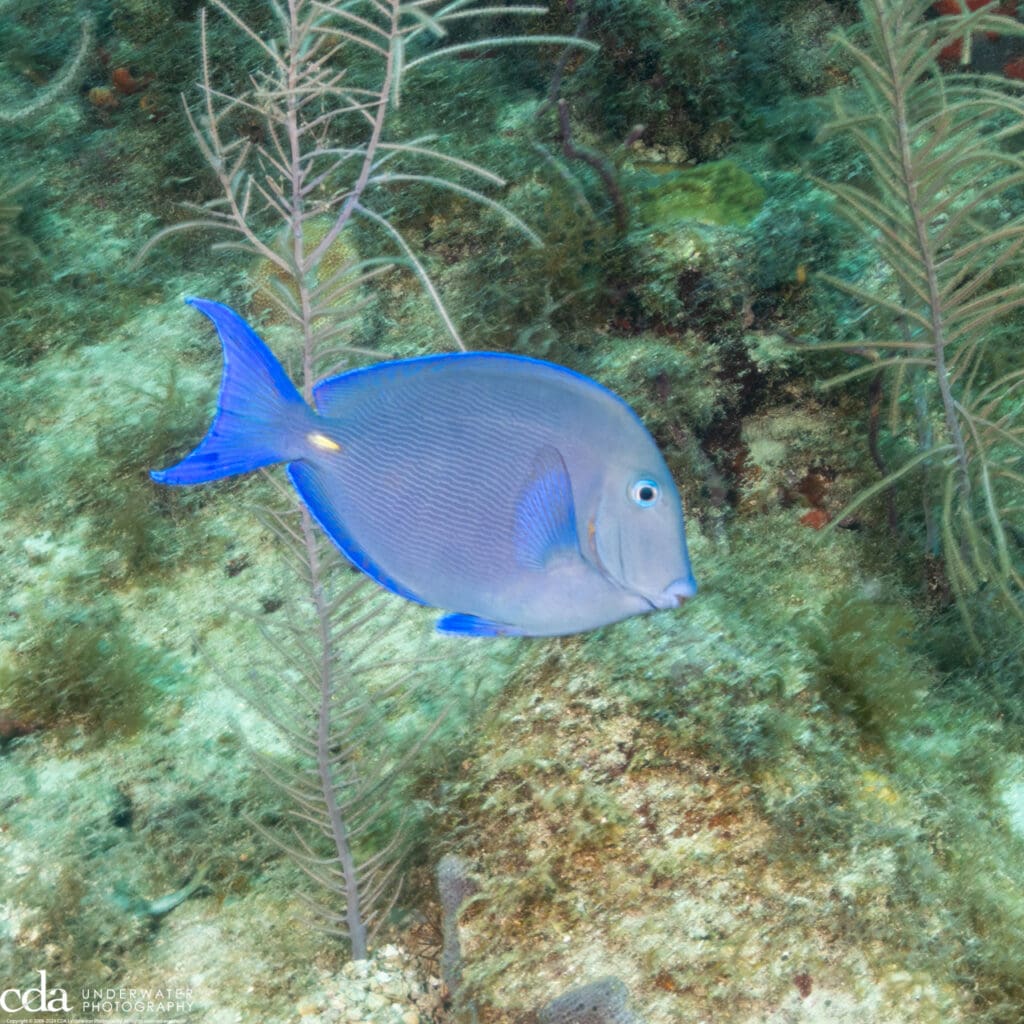
Say hello to the Atlantic Blue Tang (Acanthurus coeruleus), a vibrant blue fish with a scalpel-sharp spine near its tail. If you’re thinking of Dory from Finding Nemo, you’re close—but this species is native to the Atlantic, not the Pacific.
While many surgeonfish share the characteristic oval body and sharp scalpel-like spine near the tail, the Atlantic Blue Tang stands out with its solid, vibrant blue coloration as an adult. Juveniles, interestingly, are bright yellow, which can cause confusion with other species like the Yellow Tang (Zebrasoma flavescens), though that one is native to the Pacific. As the Blue Tang matures, it transitions from yellow to a bluish-gray and finally to a deep, rich blue, often with subtle hints of purple.
Another distinguishing feature is the uniformity of its color—unlike some surgeonfish that have stripes, spots, or multi-colored patterns, the Atlantic Blue Tang typically has a smooth, uninterrupted blue body with a slightly lighter or darker hue around the head and tail. Its tail spine, used for defense, is also more prominent and sharply defined. Behaviorally, Blue Tangs are often seen grazing in small schools on algae-covered rocks and coral, helping to keep reef surfaces clean. Their constant motion and electric blue shimmer make them one of the easiest surgeonfish to spot on South Florida reefs.
Fun Fact First:
Juvenile Blue Tangs are bright yellow, which makes them look like a completely different species until they mature. Fish that are aging into their adult colors will show a vivid blue outline around their body just before the overall change occurs. It’s like watching a caterpillar turn into a butterfly—only underwater.
The terms “surgeonfish” and “tang” are often used interchangeably, but they come from different naming traditions and can refer to slightly different groups within the same family. All tangs are surgeonfish, but not all surgeonfish are tangs. These fish belong to the family Acanthuridae, known for the sharp, scalpel-like spines located near the base of their tails—hence the name surgeonfish. These spines can be used defensively, and they’re what earned the group its surgical nickname.
The word “tang” is more commonly used in the aquarium hobby and among divers to describe certain species of surgeonfish, especially those with more compact bodies and vibrant colors, like the Atlantic Blue Tang . “Tang” likely comes from the Hawaiian word kala, which refers to these fish, and was popularized through the aquarium trade. So while the scientific classification groups them all as surgeonfish, the term “tang” has become a friendly, informal way to refer to the more colorful and commonly kept species.
Where to Find Them
Blue Tangs are common on reefs and rocky outcrops throughout South Florida. You’ll see them grazing in small schools, especially around coral heads and algae-covered rocks.
Habits and Behavior
These fish are herbivores, spending most of their time grazing on algae. Their constant nibbling helps keep reefs healthy by preventing algae overgrowth.
They’re also known for their schooling behavior, which provides safety in numbers and makes them a mesmerizing sight for divers.
What They Eat (and Who Eats Them)
Blue Tangs eat algae, scraping it off rocks and coral with specialized teeth. Their diet helps maintain the balance of the reef ecosystem.
Predators include larger fish like jacks, barracudas, and groupers. Their sharp tail spines can deliver a nasty slice, making them a tough target.
Why They’re Interesting
Aside from their role in reef health, Blue Tangs are studied for their immune systems and regenerative abilities. They’re also popular in aquariums, though wild collection is discouraged to protect reef populations.
Content created by Gen AI but edited by scuba divers for scuba divers. Photography courtesy of Christopher Duncan, copyright 2025 CDA Underwater Photography, all rights reserved worldwide.