

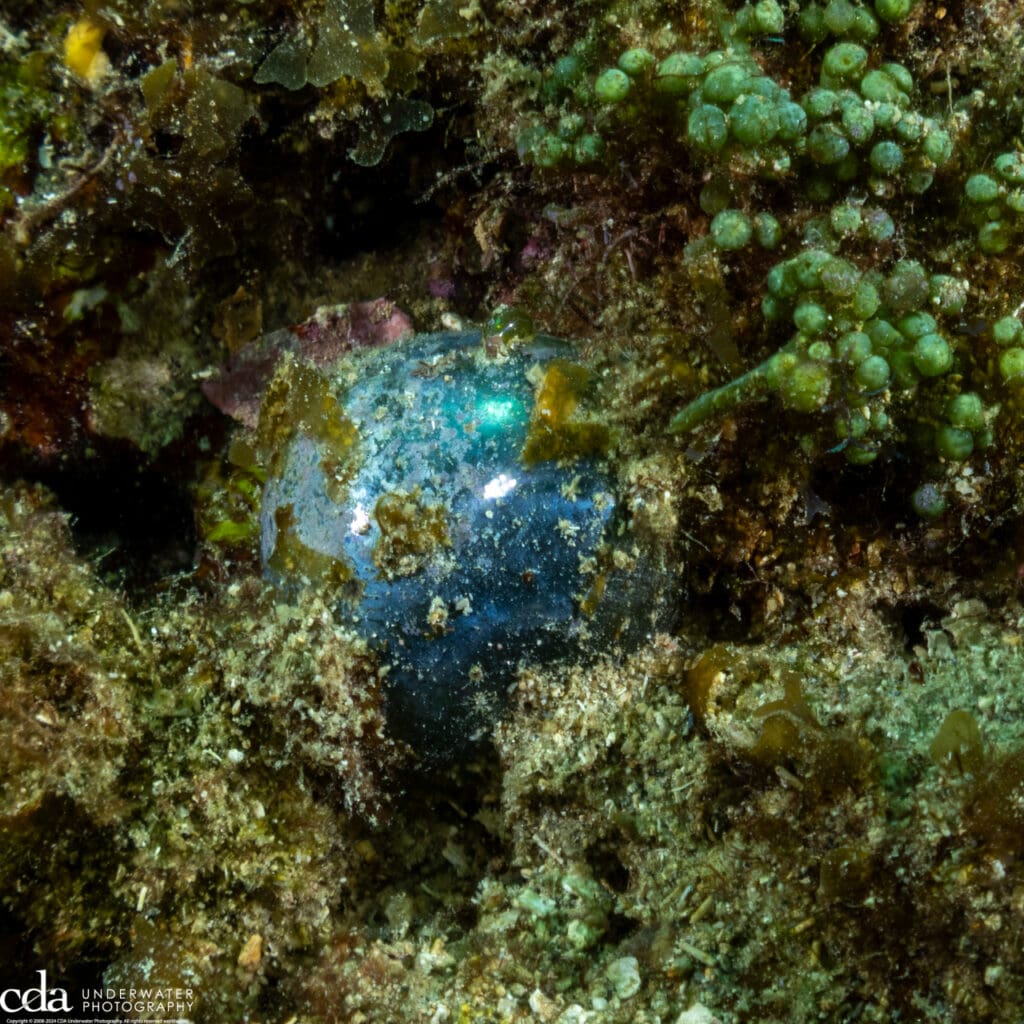
If you’ve ever been diving off the coast of South Florida and spotted shiny green bubbles clinging to rocks or coral, you’ve likely encountered Valonia Algae (Valonia ventricosa). These little spheres look like something out of a sci-fi movie—glassy, vibrant, and almost too perfect to be real.
If you’ve reached the point where you’re asking yourself “why are they talking about algae?” then read on! The size and appearance of Valonia Algae grabs a lot of people’s attention on a dive. Many divers think it’s an egg of some type when they first see it but find out it can be quite fragile if they try to “play” with it. It’s size alone (about the size of a ping pong ball) and beautiful coloration make it #FFF worthy.
Fun Fact First:
Each bubble is actually a single cell—one of the largest known single-celled organisms on Earth. That’s right, what looks like an iridescent black pearl is actually an individual cell, each one capable of photosynthesis and reproduction. It’s like nature’s version of minimalist design: simple, elegant, and surprisingly complex.
Where to Find It
Valonia Algae thrives in shallow reef zones, especially between Palm Beach County and the Florida Keys. You’ll find it attached to dead coral heads, rubble, or even seagrass beds. It prefers warm, clear water and doesn’t mind a bit of wave action.
Habits and Behavior
Valonia doesn’t move, hunt, or interact much—it’s a passive photosynthesizer. But it plays a quiet, crucial role in the reef ecosystem. By converting sunlight into energy, it contributes to the oxygen supply and supports the food chain from the bottom up.
It reproduces asexually, budding off new cells that float away and settle elsewhere. This slow spread helps it colonize new areas without overwhelming the reef.
What It Eats (and Who Eats It)
Valonia feeds on sunlight, using chloroplasts to photosynthesize. It doesn’t have predators in the traditional sense, but some herbivorous fish and invertebrates may nibble on it occasionally. More often, it provides shelter for tiny creatures like amphipods, juvenile shrimp, and even baby crabs.
Why It’s Interesting
Aside from being a biological marvel, Valonia is studied by scientists for its cell wall structure and ion transport mechanisms. Its unique properties make it a model organism for understanding cell biology and even nanotechnology.
Content created by Gen AI but edited by scuba divers for scuba divers. Photography courtesy of Christopher Duncan, copyright 2025 CDA Underwater Photography, all rights reserved worldwide.