

We just learned about the Coastal Marine Education and Research Academy (CMERA, pronounced sea-mare-uh) from new member Karen Patrick, and she had a fascinating experience that we think a lot of you would like to know about. The Coastal Marine Education and Research Academy provides field research experience, studying sharks and rays, and hands on learning opportunities to college students and other interested adults. You can join in as a citizen scientist for a week, or even join degree programs through the Moore Marine College.
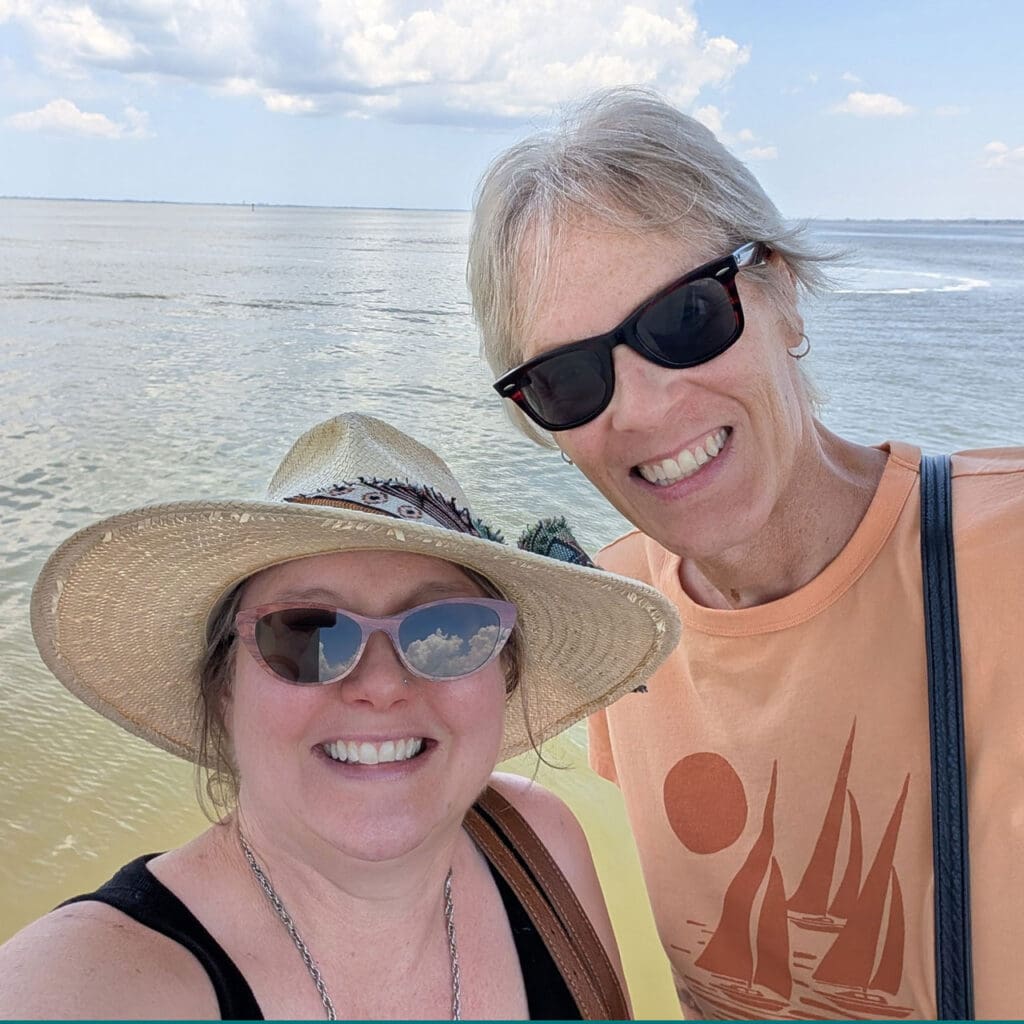
When Karen first joined Out Scuba this summer, she was excited to tell us all about her upcoming research trips. “Would you believe that just this January I was in Columbus (Ohio) and casually mentioned to my wife Susan that I was thinking of getting scuba certified?” she said. “With her encouragement that conversation turned into a whirlwind of selling our house and moving to Florida by the end of June.” And boy, are we glad she did. That’s Karen on the right and Sue in the hat.
“Now, I’ll tell anyone that sharks have been my passion ever since my first encounter with a nurse shark in California at the age of seven. I can still remember my awe and joy at watching a nurse shark swim right past me! That shark was the coolest animal I’d ever seen, and I immediately wanted to learn more,” she explained. “Like most kids of my generation, I watched Jaques Cousteau with wide eyes and was fascinated by the world below the waves. That show shaped my view of the ocean and taught the importance of viewing marine life with curiosity and respect. I dreamed of one day maybe being able to see it in person, but, as a kid growing up in a small Ohio town the ocean was a world away.”
As the CMERA website explains, “students attending one through three weeks of our summer program will be considered Research Scientists on the project. During the week, students will be on the boats Monday through Friday, learning how to set and retrieve various types of research gear, safely handle animals, and properly apply identification tags and PIT (Passive Integrated Transponder) tags.”
Karen got her chance to participate as a marine biology student/volunteer during August. She called it “the experience of a lifetime.”
“We were either using tangle nets or setting long lines off the coast of Clearwater. Each day was full of hands-on experiences of tagging and measuring sharks and rays. Ever wondered how shark skin compares to a ray? Or how hard it is to get a pit tag onto a bull shark? And will a remora stick to your skin? Answer on that last one is “not if it doesn’t want to!” If you love sharks and rays and want to learn more about ocean life and conservation, absolutely look into this program!” she thrilled.
CMERA’s program teaches participants techniques to handle the animals in a quick and safe manner, always keeping the animal’s safety first and foremost. Like a racing pit crew, time is of the essence, and volunteers must focus to protect the animal and each other. “Several people help hold the animal still without hurting it. Others use a hose to pump water over the shark’s gills or the ray’s spiracles. Team members “on data” are busy recording size and gender. More than a few times I looked a shark in the eye and whispered sweet nothings to help calm it (squee!)” she added.
“We caught and tagged numerous southern rays, a few Atlantic and cow nose rays, two lemon sharks (6 and 7 feet long), a blacktip shark, three blacknose sharks, a green turtle (which we released without tagging because that species was outside the scope of our permits), and our proudest specimen of the two weeks I was there, an 8-foot-long bull shark,” she continued.
“That bull was caught on rod and reel; we finally wrangled it onto the boat after it circled for three hours. Once we landed him on the boat we sprang into action, knowing how tired and stressed our boy was. I was on ‘tail duty’ and hung on with all I had to keep him from hurting himself or the team. It was my proudest moment of the trip! Everyone worked together quickly and competently to return these animals safely to the water in just a few moments. It was impressive to witness and inspiring to be a part of this program.”
Karen’s enthusiasm is intoxicating as she explains her life journey that put her on that shark’s tail at the tender age of 54. “Odds are if you have a passion (and you know by now that mine is sharks) then there is opportunity to learn. One may see that and think “duh, Karen?” but chasing dreams is very new to me. In a world that literally told me not to dare to dream, I had the audacity to imagine and create an entirely new life for myself in my 30s and again in my 50s.”
So, back to that conversation with her wife… “we talked about the challenges of getting ocean-diving experience from Ohio. If only there was a way… we found one by moving to the Sunshine State! And, hey, what could go wrong being a Trans person in Florida? I was scared as hell if I’m being honest. I’m guessing the “living in Florida as a Trans person” anxiety won’t ever go away, so, it’s time to chew bubblegum and dive… and I’m all out of bubblegum.”
She wrapped up our conversation this way: “Long story short. Do dream. Do take a chance on something out of your comfort zone. And if you think you may be too old to do this then think again. I’m 54 and wasn’t the youngest person there. Just the queerest. ;-)”
Welcome to Florida, Karen, and welcome to Out Scuba!