

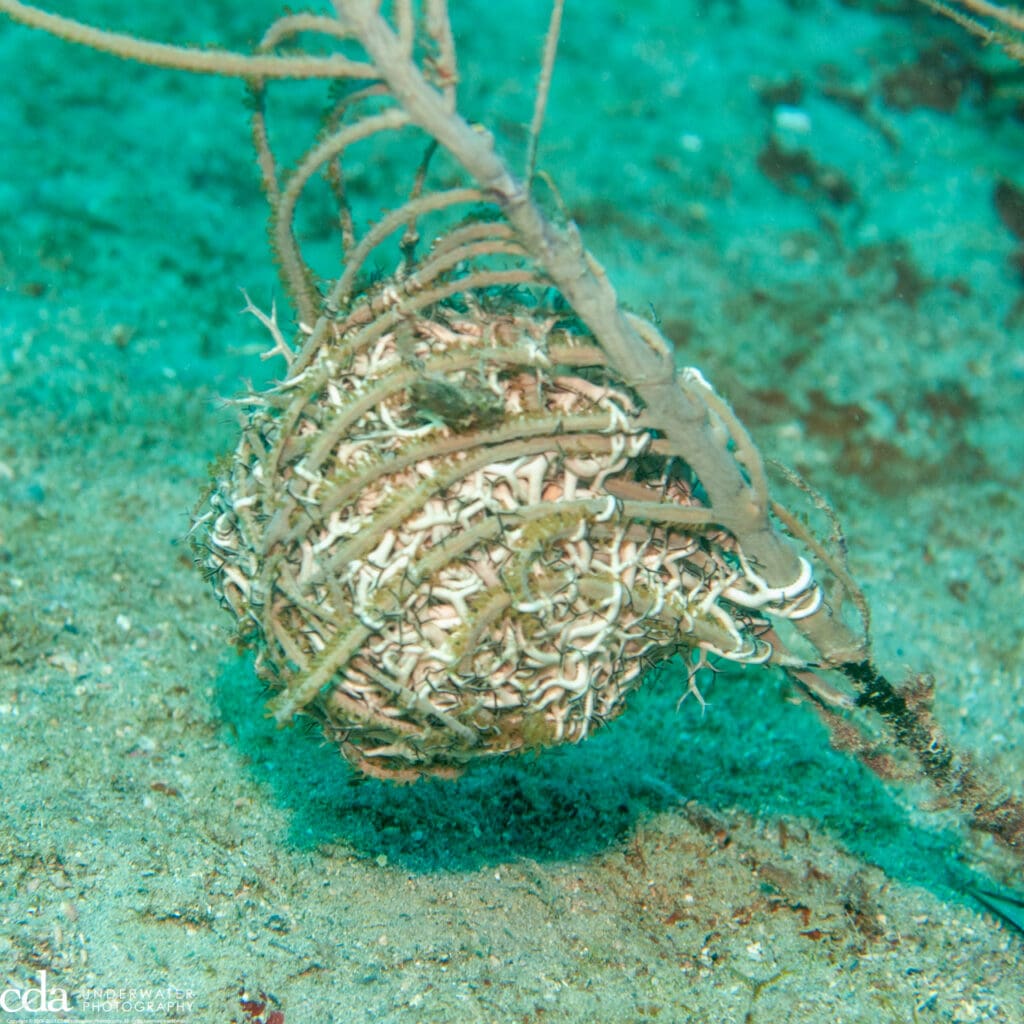
If you’ve ever done a drift dive over a soft coral reef in South Florida , you may have seen a Giant Basket Star (Astrophyton muricatum) and never known it. During the day these amazing creatures curl into a tangled ball of spaghetti and wrap the soft coral around themselves. Even the biggest would only be about the size of a softball when in day-mode but can unfurl into a delicate monster up to a meter across.
This nocturnal echinoderm is part alien, part acrobat, and entirely captivating. And lucky for us, our local reefs—especially those lush with soft corals and gorgonians—are prime real estate for these elusive invertebrates.
What are Gorgonians?
Gorgonians, or soft corals, belong to the order Alcyonacea, and they’re commonly called sea fans, sea rods, or sea plumes depending on their shape and structure. Unlike stony corals that build reefs, gorgonians are flexible and sway with the current, forming underwater forests that create the perfect habitat for small fish, invertebrates… and yes, giant basket stars!
They’re anchored to the reef with a central skeletal axis made of gorgonin, a protein substance that gives them strength and flexibility—kind of like cartilage in human ears. Their polyps extend to feed on plankton, but during the day, many gorgonians act as cozy real estate for critters like basket stars to rest and hide.
Why Gorgonians Make the Perfect Hideaway
Fort Lauderdale’s underwater landscape is dominated by soft corals that sway gently in the current, creating a forest-like canopy that’s ideal for basket stars to tuck into during the day.
Basket stars are nocturnal, meaning they spend daylight hours curled into a tight ball, often nestled deep within the branches of a gorgonian. The structure offers camouflage from predators and protection from strong currents. Think of it as their cozy hammock until the sun goes down.
And when it does? That’s when the magic happens.
The Unfurling Ritual
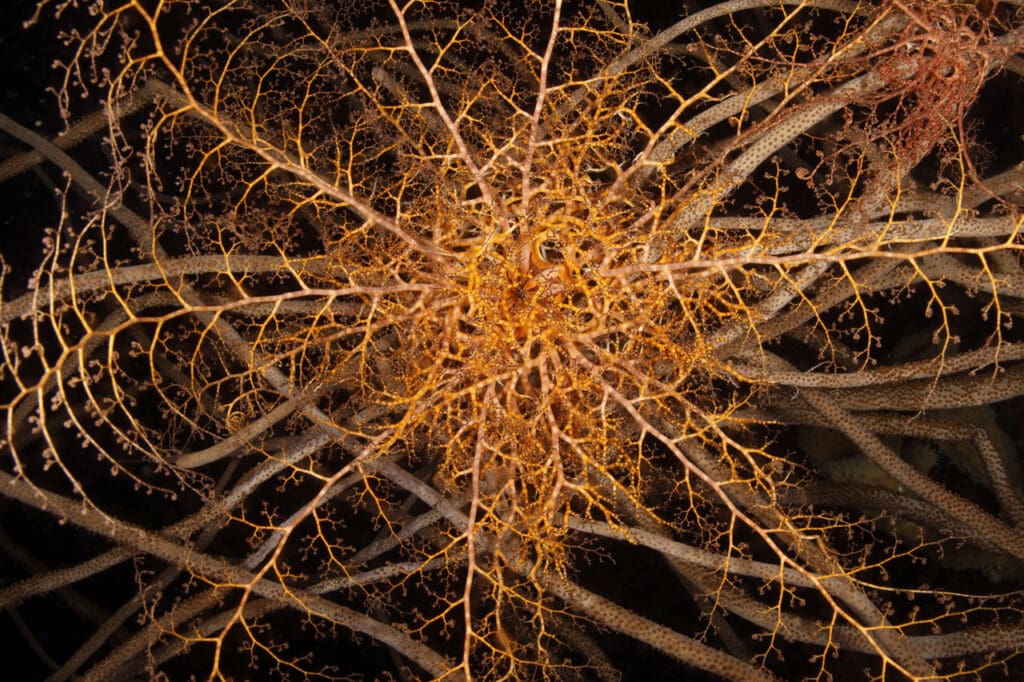
Around dusk, when the reef begins its nightly transformation, the basket star climbs to a high perch—often the top of a gorgonian or coral head—and begins to unfurl its arms. And what arms they are! Each of its five main arms branches and re-branches into a fractal-like net that can span nearly a meter across.
This intricate web isn’t just for show. It’s a plankton trap, designed to snare tiny organisms drifting in the current. The basket star positions itself facing the flow, arms extended like a living satellite dish. When a morsel touches the net, the smallest branches curl around it, forming a ball that’s passed down to the mouth at the center of its disc.
It’s a slow, deliberate process—almost meditative to watch. But don’t shine your dive light too long. If startled, the basket star will curl back into its protective ball, taking several minutes to reset.
What’s on the Menu?
Basket stars are carnivorous suspension feeders. Their diet includes:
- Zooplankton
- Tiny shrimp
- Juvenile fish
- Organic detritus
They don’t chase their food—they catch it. Their feeding strategy is passive but effective, relying on water movement and their finely branched arms to do the heavy lifting.
Do They Move Around?
Yes, but slowly. Basket stars aren’t glued to one gorgonian for life. They can and do move between perches, especially if their host coral becomes damaged or dies. In fact, during coral bleaching events, researchers have observed basket stars shifting habitats, sometimes clinging to exposed stony corals when their preferred gorgonians are no longer viable.
That said, they’re not marathoners. Movement is deliberate and usually happens under cover of darkness. If you spot one in the same place on multiple night dives, it’s probably found a sweet spot with just the right current and buffet line.
Should Divers Ever Try to Uncurl One?
Short answer: nope.
Long answer: Basket stars are delicate creatures. Their arms are covered in tiny, sensitive branches that can be easily damaged. If you find one curled up during the day, it’s resting or hiding. Trying to uncurl it—even gently—can cause stress or injury.
Instead, the best way to observe them is to:
- Dive at night, ideally after sunset
- Use a red filter on your light to avoid startling them
- Approach slowly and respectfully
- Watch from a distance as they unfurl naturally
Trust me, the reward is worth the patience.
Where to Spot Them in Our Area
Some of the best places to find basket stars locally include:
- Sea Fan Alley: A gorgonian-rich stretch off Lauderdale-by-the-Sea
- Tenneco Towers: Especially the shallower sections with abundant soft coral growth
- Hollywood North Beach Reef: A great shore dive with plenty of sea rods and plumes
Look for healthy gorgonian colonies—especially sea plumes (Antillogorgia americana) and sea rods (Plexaura spp.). Basket stars tend to favor these for their height and branching structure.
Fun Facts to Impress Your Dive Buddies
- The basket star’s arms can regenerate if damaged—though it takes time.
- They belong to the class Ophiuroidea, making them relatives of brittle stars.
- Their genus name, Astrophyton, means “star plant”—a nod to their floral-like appearance.
- They’re not venomous, but their arms are incredibly fragile.
Final Thoughts
The giant basket star is one of South Florida’s most enchanting reef residents. It’s a creature of mystery, elegance, and quiet power—feeding with grace, hiding with intention, and unfurling like a living sculpture when the reef goes dark.
So next time you’re night diving among the gorgonians, keep your eyes peeled. You might just catch a basket star in the act of becoming its full, glorious self.
And if you do—float still, breathe slow, and enjoy the show.